INDIA’S PRIVATE SCHOOL TRAP: WHEN FAMILIES GO HUNGRY TO PAY FEES
By idmahamad sekh
INDIA’S PRIVATE SCHOOL TRAP: WHEN FAMILIES GO HUNGRY TO PAY FEES
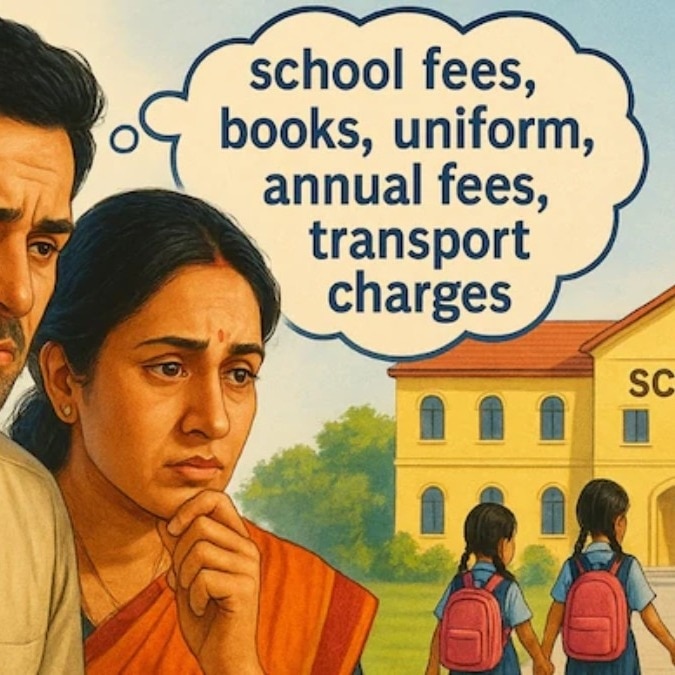
In a country where the Right to Education is a constitutional promise, millions of Indian families are forced into an impossible choice: pay private school fees or sacrifice essentials like food, medical care, and house rent.
This is not a cultural shift—it is a structural failure. The collapse of government schools pushes families into the arms of private institutions, turning education from a public right into a market commodity.
Private schooling was supposed to offer quality and choice. Instead, it has produced a silent humanitarian crisis—a nation of parents taking loans, selling jewellery, and skipping meals to keep their children enrolled.
A System Where the Poor Pay More Than the State
The data is unambiguous. According to the National Sample Survey (NSSO), over 47% of India’s education spending now happens in private institutions, while public school budgets stagnate. This economic shift isn’t driven by luxury—it is driven by desperation.
In Haryana, Uttar Pradesh, West Bengal, and Maharashtra, families earning ₹8,000–₹12,000 a month routinely pay ₹1,000–₹2,500 per child in fees—sometimes more during “annual charges,” “development fees,” or “maintenance funds.”
A father in Ghaziabad who works as a security guard explained:
“We cut milk. We cut vegetables. But if we don’t pay school fees, they remove our children from class.”
This is not a financial decision. It is coercion disguised as aspiration.
The Psychological Burden: Children Who Know They Are Expensive
In slums across Delhi and Mumbai, children as young as 10 understand the cost of their education. They watch their parents borrow money, take weekend jobs, or pawn belongings to pay school fees.
The trauma is quiet but lasting.
A mother in Kolkata said:
“My son asked me, ‘Ma, if I fail, will you be able to afford me next year?’”
This is what happens when a constitutional right becomes a private bill. Children feel like liabilities—not citizens with guaranteed dignity.
How Private Schools Exploit a Weak Regulatory System

Private schools operate with near-total freedom:
• They raise fees annually without justification.
• They add compulsory “extras” like smart classes or activity fees.
• They withhold report cards and transfer certificates during disputes.
• They expel children for delayed payments.
State-level Fee Regulation Committees exist on paper, but enforcement is weak, irregular, and often influenced by private school lobbies.
The result? A market where profit takes priority and parents have no bargaining power.
Government Schools Are Failing—And the Poor Are Paying the Price
The private school explosion wouldn’t exist if public schools delivered quality.
But government institutions suffer from:
• Teacher shortages
• Dilapidated infrastructure
• No accountability
• Outdated pedagogy
• Chronic underfunding
Parents do not choose private schools out of luxury—they choose them because the system gives them no alternative.
A rickshaw-puller in Varanasi put it plainly:
“Government school is free. But free becomes costly if the child learns nothing.”
This single sentence explains the core tragedy.
The Ripple Effect: Debt, Malnutrition, and Lost Futures
When school fees dominate a household budget, everything else shrinks.
• Families cut meals
• Children skip medical treatment
• Parents take informal loans at 4–10% monthly interest
• Girls are pulled out first when the burden grows
Education, meant to be an equalizer, becomes a pipeline into deeper poverty.
India has created a system where the poor subsidize the failure of the state, paying private institutions for a public good.
The Way Forward: Fixing What the Market Cannot
No amount of fee regulation can solve the root issue. Only strong public schools can.
Countries with high literacy—Finland, South Korea, Japan—invest heavily in free, quality public education. India’s budgetary commitment, meanwhile, stays far below global standards.
Until government schools regain dignity, private school fees will continue to rise and parents will continue to bleed.
The crisis is not about affordability.
It is about a nation outsourcing its future to the market
What Comes Next
Next in this investigation: How groundwater collapse turned Indian cities into permanent water-scarcity zones.
The 100-Metre Blind Spot: How a Provisional Definition Puts North India’s Water at Risk
Leave a Reply