Election Commission Appointment System Explained | TruthWave Block 7
By idmahamad sekh
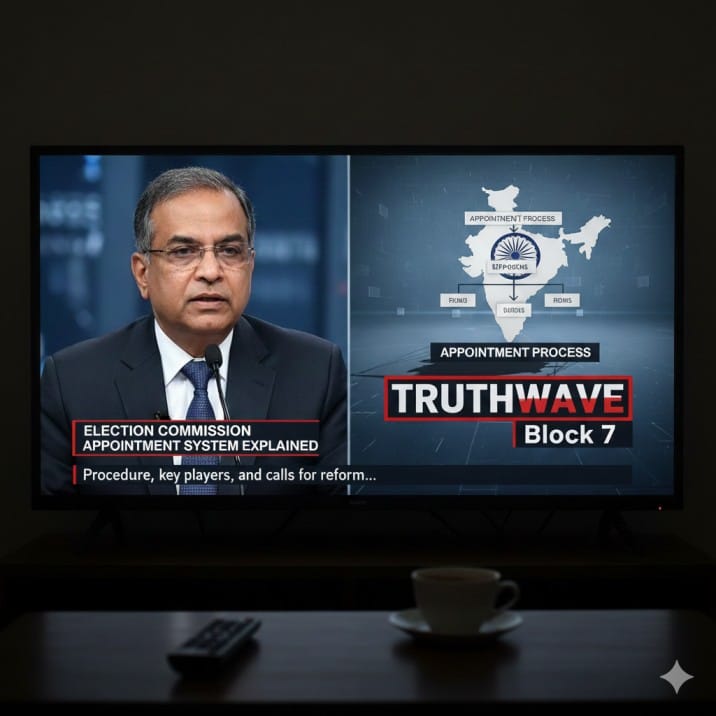
APPOINTMENT SYSTEM POWER MAP: HOW GOVERNMENTS SHAPE THE ELECTION COMMISSION OF INDIA
TruthWave Level-5 Public Investigation | Block 7 of 25
SUMMARY
The appointment of India’s Election Commissioners has always been controlled by the ruling government. This structural flaw has allowed every political era—not just one—to influence the Election Commission’s leadership. The Supreme Court tried to correct this in 2023, but Parliament reversed the reform. Block 7 exposes how the appointment system became the ECI’s weakest link.
INTRODUCTION — THE ROOT OF ECI’S WEAKNESS
Every institution’s independence depends on how its leaders are chosen.
For 70+ years, India followed a system where:
The ruling government alone appointed Election Commissioners.
No bipartisan committee.
No judicial oversight.
No parliamentary review.
No transparency.
This meant that:
- Governments could appoint favorable commissioners
- Officers could be influenced indirectly
- Commissioners might hesitate to anger the government that appointed them
This is not a “current government” issue.
This is a structural design flaw that every government used.
TruthWave explains how the flaw evolved.
SECTION 1 — HOW APPOINTMENTS WORKED SINCE 1950
The original process:
President formally appoints Commissioners
President acts on advice of Prime Minister (executive)
No opposition role
No judicial role
No independent committee
This meant:
The ruling party effectively chose the referee of Indian elections.
This system continued through:
- Congress era
- Coalition era
- UPA era
- NDA era
- Current era
TruthWave Commentary
No democracy should let the players choose the referee.
But India allowed that for 70 years.
SECTION 2 — HISTORICAL PATTERN OF GOVERNMENT INFLUENCE (NONPARTISAN)
During Congress/UPA Era
Opposition claimed:
- Appointments were politically convenient
- Commissioners favored ruling party decisions
- MCC enforcement was selective
- Election scheduling was strategic
These allegations are documented in Block 2.
During NDA Era
Opposition claimed:
- Commissioners were aligned to ruling interests
- Dissenting Commissioners (e.g., Ashok Lavasa) were sidelined
- New commissioners were appointed during sensitive cases
- Favorable orders were passed
Same pattern, different era.
TruthWave Commentary
When the SAME allegations appear under DIFFERENT governments,
the problem is structural—not political.
SECTION 3 — THE ANOOP BARANWAL JUDGMENT (2023): A HISTORIC SHIFT
In March 2023, the Supreme Court said:
“Appointment of Election Commissioners only by the executive is unconstitutional.”
Source:
(https://main.sci.gov.in/supremecourt/2021/35064/35064_2021_1_1501_41441_Judgement_02-Mar-2023.pdf)
The Court ordered a temporary reform:
Appointment Committee
- Prime Minister
- Leader of Opposition
- Chief Justice of India
This would have:
- Ended unilateral government control
- Increased public trust
- Reduced political pressure
- Protected Commissioners from fear
This was the most significant ECI reform in 70 years.
TruthWave Commentary
This was the moment India almost built a real independent Election Commission.
Almost.
SECTION 4 — PARLIAMENT’S NEW LAW (2023): A REVERSE MOVE
Months after the judgment, Parliament passed a new law:
The Chief Justice of India was removed from the committee.
New committee:
- Prime Minister
- Cabinet Minister (from ruling party)
- Leader of Opposition
This meant:
The ruling government again held 2 out of 3 votes.
Opposition and civil society argued this weakened the Court’s intention.
Critics said:
- The neutrality safeguard was removed
- Independence became symbolic
- Government influence was restored
TruthWave Commentary
The Supreme Court opened the door to independent appointments.
Parliament closed it.
This shows that institutional reform cannot depend on court orders alone.
It needs political courage—which India’s system has yet to show.
SECTION 5 — WHY APPOINTMENTS MATTER (REAL EVENTS)
Case: Ashok Lavasa’s dissent
When Lavasa dissented on MCC cases, he faced pressure and shortly left ECI.
This showed:
A Commissioner who does not align with ruling expectations can be isolated.
Case: Timing of new Commissioner appointments
In several instances, Commissioners were appointed during major political controversies, raising public suspicion.
Case: Majority voting inside ECI
CEC + 2 ECs = decisions by majority.
If government-appointed Commissioners align with each other,
the third Commissioner’s dissent becomes meaningless.
TruthWave Commentary
Appointments do not control decisions directly.
They control the environment in which decisions are made.
Independence becomes psychological, not legal.
SECTION 6 — GLOBAL COMPARISON: HOW DO OTHER DEMOCRACIES APPOINT THEIR ELECTION CHIEFS?
Canada
Independent parliamentary committee.
No prime ministerial dominance.
United Kingdom
All appointments reviewed by an ALL-PARTY parliamentary committee.
Mexico
Election commissioners selected by a two-thirds parliamentary supermajority.
South Africa
Independent selection panel with civil society participation.
Australia
Judicial and parliamentary oversight.
TruthWave Commentary
India’s model gives the ruling government maximum control.
Most democracies split appointment power deliberately—
to prevent both real and perceived capture.
India does not.
SECTION 7 — THE REAL PROBLEM: APPOINTMENTS CONTROL THE CULTURE OF THE ECI
When Commissioners know:
- Who appointed them
- Who can influence them
- Who controls promotions
- Who controls future assignments
it affects:
- Tone
- Courage
- Skepticism
- Transparency
- Willingness to challenge power
This is human nature, not conspiracy.
TruthWave Commentary
Institutions don’t become weak overnight.
They become weak gradually,
when leadership fears displeasing the system that created them.
SECTION 8 — TRUTHWAVE REFORM BLUEPRINT
1. A fully independent appointment committee
- PM
- Leader of Opposition
- CJI
- Speaker of Lok Sabha
- Two civil society members
2. Public release of shortlists
3. Minimum qualifications criteria
4. Transparent interview process
5. Cooling-off period before appointment
6. Removal of executive dominance
India deserves an appointment system that ensures commissioners are not indebted to any party.
CONTINUE TO BLOCK 8
Block 8 exposes why the ECI is administratively dependent on the government:
- Budget controlled by Law Ministry
- No independent staffing
- Reliance on state machinery
- Transfer politics
- Police and district administration dependence
[…] (TruthWave):For a deeper explanation of how appointment power shapes institutional independence, see TruthWave Block 7: Election Commission Appointment System Explained. […]