EVMs, VVPATs & Transparency in Indian Elections | TruthWave Block 9
By idmahamad sekh
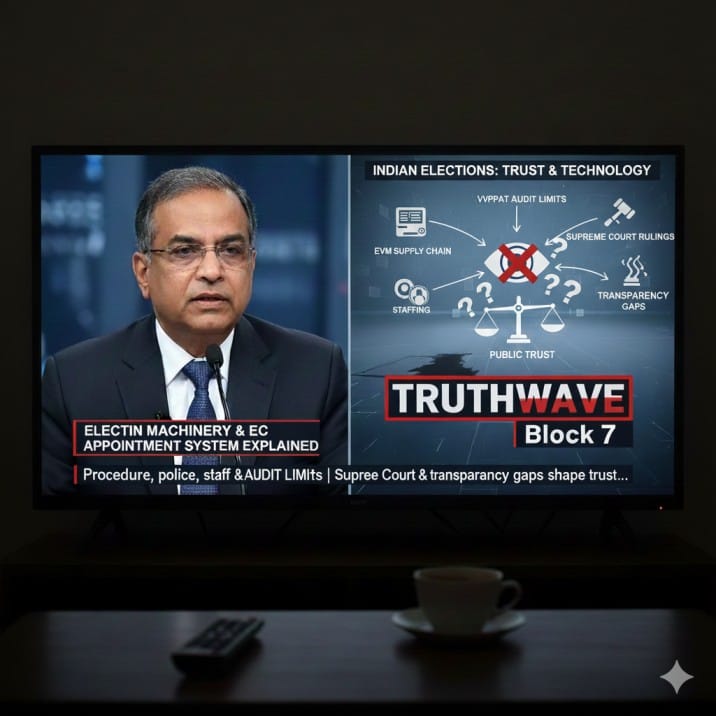
EVMs, VVPATs & TRANSPARENCY: TECHNOLOGY, TRUST & THE SUPPLY CHAIN NOBODY TALKS ABOUT
TruthWave Level-5 Public Investigation | Block 9 of 25
SUMMARY
India’s EVM system is widely praised for efficiency — yet deeply questioned for transparency. Political parties, civil society, technical experts, and even Supreme Court judges have raised concerns about limited audits, PSU-controlled supply chains, data opacity, and the narrow VVPAT verification percentage. Block 9 explains the full picture with raw evidence and simple clarity.
INTRODUCTION — TECHNOLOGY IS NOT THE PROBLEM. TRUST IS.
India’s EVMs are engineering achievements.
They are not the issue.
The issue is:
Who controls the technology
Who audits the technology
Who oversees manufacturing
Who controls data
Who ensures transparency
Who verifies results
For 20 years, many institutions and individuals have asked the same question:
“How do we trust what we cannot verify?”
TruthWave now breaks down everything the public must understand.
SECTION 1 — HOW INDIA’S EVM SYSTEM ACTUALLY WORKS
EVMs consist of:
- Ballot Unit (BU)
- Control Unit (CU)
- VVPAT machine (added after 2013–2019 SC pressure)
EVMs do NOT connect to Wi-Fi
They do NOT have modems
They run on standalone microcontrollers
They can record votes reliably
But the weakness is not the technology—
it is the auditability.
SECTION 2 — THE SUPPLY CHAIN: WHO MAKES INDIA’S EVMs?
EVMs and VVPATs are manufactured by:
BEL (Bharat Electronics Ltd.)
Under Ministry of Defence.
ECIL (Electronics Corporation of India Ltd.)
Under Department of Atomic Energy.
This means:
The same government that contests elections controls the manufacturing units that build the voting machines.
This is not about which government.
This has been true under:
- UPA
- NDA
- All earlier governments
Public-domain documentation:
https://bel-india.in
https://www.ecil.co.in
TruthWave Commentary
Technology should serve democracy,
not be structurally vulnerable to control by the executive.
Even if machines are secure,
trust collapses when the supply chain is not independently supervised.
SECTION 3 — WHAT THE SUPREME COURT SAID ABOUT VVPATs
2013 — SC Directs ECI to Introduce VVPAT
Source:
https://indiankanoon.org/doc/102317645/
“Paper trail is indispensable for free and fair elections.”
This judgment changed Indian election technology forever.
2019 — SC Orders Increase in VVPAT Verification
Supreme Court asked ECI to increase VVPAT verification from:
- 1 booth per constituency
to - 5 booths per constituency
But parties demanded 100%.
ECI resisted strongly.
TruthWave Commentary
The court repeatedly pushed for transparency.
The ECI repeatedly resisted.
Resistance itself reduces credibility.
SECTION 4 — THE 1% AUDIT PROBLEM (THE CORE ISSUE)
In India:
Only about 1% of VVPAT slips are verified against electronic results.
In the world’s largest democracy, this level of audit is:
- Too small
- Statistically insufficient
- Not internationally comparable
- Vulnerable to doubt
Globally:
- Germany bans EVMs without full audit
- Netherlands abandoned EVMs
- US uses paper-ballot audits
- UK uses paper ballots
- Canada uses machine scanning with audits
India uses 1% audits on a system that determines the fate of 960 million voters.
TruthWave Commentary
Machines do not build trust.
Verification builds trust.
India audits almost nothing.
SECTION 5 — WHY THERE IS NO INDEPENDENT TECHNICAL AUDIT
This is one of the biggest transparency gaps.
There is NO:
- external audit
- third-party audit
- open-source code audit
- international audit
- independent security testing
- post-election verification audit
Who audits EVMs?
Only the manufacturers — BEL & ECIL.
This is like:
A company checking its own exam paper and declaring itself the topper.
It doesn’t matter if the machines are good—
the process is not credible.
TruthWave Commentary
When the referee’s tools are audited by the team playing the match,
public trust naturally collapses.
SECTION 6 — WHAT TECHNICAL EXPERTS HAVE SAID (NONPARTISAN SUMMARY)
Experts who trust EVMs
Say machines are secure because:
- No internet
- One-time programmable chips
- Hardware-based design
- Tamper-proof seals
Experts who question EVMs
Say machines need:
- Open audits
- Random code checks
- Larger VVPAT auditing
- Tamper-evidence logs
- Independent verification
TruthWave does not take sides.
TruthWave focuses on evidence and transparency standards.
SECTION 7 — STORAGE, TRANSPORT & SECURITY VULNERABILITIES
Even if machines are secure technically,
they face logistical vulnerabilities:
Mislabelled storage rooms
Delayed sealing
Missing CCTV footage
Unauthorized entry incidents
Police dependency
Local administration dependency
Weak chain-of-custody documentation
Examples of reported incidents exist across multiple states and years—
not tied to any single government.
TruthWave Commentary
Technology does not fail.
Systems fail.
Chain-of-custody failure is the biggest global red flag in election management.
SECTION 8 — TURNOUT MISMATCH CONTROVERSIES (LINKED TO EVM/VVPAT TRUST)
As covered in Blocks 2 and 6:
Turnout numbers change after polling
Final numbers come late
Booth-wise data not released publicly
Form 17C not posted online
Civil society demanded transparency
Public trust declines whenever numbers change without explanation.
TruthWave Commentary
A transparent system does not hide data.
It publishes everything instantly.
SECTION 9 — TRUTHWAVE’S RECOMMENDED REFORMS
100% VVPAT audit
Mandatory independent audits
Open-source code review
International observers for tech processes
Public release of Form 17C for every booth
Independent chain-of-custody monitoring
EVM manufacturing oversight committee with opposition + civil society
Random machine swapping procedures
GPS logs of machine movement
India has the world’s largest democracy.
It must also have the world’s most trusted system.
CONTINUE TO BLOCK 10
Block 10 covers turnout controversies, including:
- Sudden turnout jumps
- Inconsistent data release
- Civil society findings
- ECI explanations
- Booth-level transparency failures
- TruthWave’s analysis
Leave a Reply