The Future of India’s Election Commission:
By idmahamad sekh
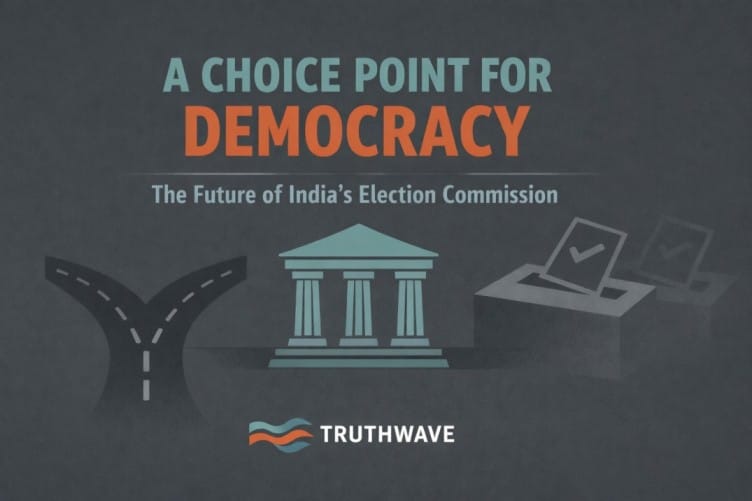
TruthWave Level-5 Public Investigation | Block 25 of 25
Choices, Consequences, and the Road Ahead
SUMMARY
India’s Election Commission stands at a crossroads. Over the past two decades, structural gaps, delayed reforms, and institutional dependencies have gradually reshaped its role—from an autonomous referee to a body increasingly reliant on courts, administration, and political cooperation. Block 25 brings together the findings of all previous blocks and examines the choices ahead—and the consequences of action or continued delay.
INTRODUCTION — THE QUESTION IS NO LONGER WHAT WENT WRONG
Across this investigation, one conclusion is clear:
India’s election system did not weaken overnight, nor did it fail suddenly.
Instead, the Election Commission’s challenges accumulated gradually—through delayed reform, incomplete autonomy, uneven enforcement, and growing reliance on external correction. The future now depends not on diagnosis, but on decision.
WHAT THE INVESTIGATION ESTABLISHED
Across 25 blocks, the evidence shows:
- Appointment processes concentrated influence instead of dispersing it
- Legislative reform lagged behind judicial warnings
- Administrative dependence limited enforcement capacity
- Timing and delay altered outcomes without changing rules
- Transparency expanded slowly, unevenly, and cautiously
- Courts became routine stabilisers instead of exceptional correctives
These were not partisan failures.
They were structural outcomes.
THREE POSSIBLE FUTURES FOR THE ECI
1. CONTINUED STATUS QUO
If no major reform occurs:
- Courts will remain the primary safeguard
- Enforcement will remain uneven
- Public trust will depend on perception, not clarity
Elections will continue—but credibility will remain contested.
2. PARTIAL, SYMBOLIC REFORM
Incremental changes may:
- Improve optics
- Address isolated issues
- Reduce immediate criticism
But without structural change, underlying vulnerabilities will persist.
3. STRUCTURAL RENEWAL
Meaningful reform would involve:
- Independent, multi-institutional appointments
- Statutory enforcement authority
- Administrative autonomy
- External oversight and transparency
This path is difficult—but stabilising.
THE ROLE OF INSTITUTIONS
No single institution can fix the system alone:
- Parliament must legislate beyond minimum compliance
- The Executive must accept reduced control
- The Judiciary must remain a backstop—not a substitute
- The Election Commission must embrace scrutiny as strength
Democracy requires coordination—not concentration.
Verification sources:
Parliament of India
https://www.parliamentofindia.nic.in
Supreme Court of India
https://main.sci.gov.in
Election Commission of India
https://eci.gov.in
THE PEOPLE’S STAKE
A voter from West Bengal summarised the public expectation simply:
“We don’t expect perfection. We expect clarity—and fairness that we can see.”
This investigation shows that trust follows explanation, not assertion.
WHAT THIS INVESTIGATION DOES NOT CLAIM
TruthWave does not claim:
- Elections are illegitimate
- Institutions are captured
- Outcomes are manipulated
It demonstrates how systems drift when reform is postponed, even with good intent.
WHY THIS MOMENT MATTERS
India conducts the world’s largest elections.
Scale magnifies both strength and weakness.
Without renewal, even resilient systems accumulate strain.
This is not a crisis narrative.
It is a choice point.
TRUTHWAVE FINAL FINDING
The Election Commission of India is not broken.
It is unfinished.
Its future depends on whether India chooses:
- Repeated correction
or - Structural completion
Democracy does not fail loudly.
It weakens quietly—unless renewed deliberately.
For the structural reform roadmap, see TruthWave Block 24: What Real Electoral Reform Would Require.
LEGAL-SAFETY NOTE
This investigation examines institutional systems and publicly available data. It does not allege individual wrongdoing.
Leave a Reply