Why India’s Urban Water Crisis Is Structural, Not Seasonal — Explained
By idmahamad sekh
INVESTIGATION NOTICE
This article is part of an ongoing TruthWave public investigation into India’s urban water crisis.
Over the coming weeks, TruthWave will publish a multi-part, evidence-based investigation examining how India’s cities reached a state of permanent water scarcity. Each report will focus on one system failure — governance, groundwater collapse, urban planning, private profiteering, inequality, and accountability.
This first report explains why recurring water shortages in Indian cities are not caused by weak monsoons alone, but by structural failures built over decades. Subsequent articles will document how the crisis was created, who benefits from it, and what genuine reform would require.
Readers are invited to follow this investigation block by block.
FULL ARTICLE
At 4:30 a.m. in Chennai, a private water tanker reverses into a narrow residential street. Plastic drums are already lined up. By sunrise, the tanker is empty. The price of a single load has doubled compared to last year. For many families, that one delivery now costs nearly a full day’s income.
Scenes like this are no longer limited to drought years. They are common in Bengaluru, Delhi, Hyderabad, and parts of Mumbai — even in years when monsoon rainfall is close to normal.
This contradiction points to a deeper truth.
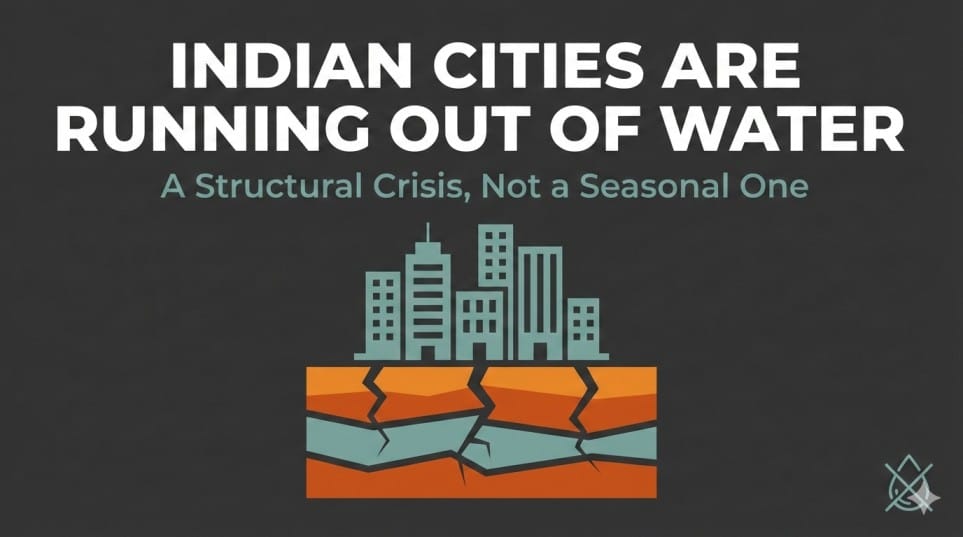
India’s urban water crisis is not seasonal. It is structural.
The Rainfall Explanation Falls Apart
India is not a water-poor country by rainfall standards. According to the India Meteorological Department, the country receives an average annual rainfall of around 1,170 millimetres, and several recent years have recorded near-normal or above-normal monsoon levels
https://mausam.imd.gov.in/
If rainfall were the main cause of water shortages, scarcity would rise and fall sharply with monsoon performance. Instead, most major cities experience chronic shortages every year, regardless of rainfall levels.
Rain arrives. Water still disappears.
This gap reveals that the problem lies not in nature, but in how water is governed.
A System With No Single Owner
Urban water management in India is split across multiple institutions.
Municipal bodies manage daily distribution. State departments control reservoirs. Pollution control boards oversee quality. Groundwater regulation is assigned to separate authorities, often with weak enforcement.
When water fails to reach households, responsibility is spread so thin that no single institution is held accountable.
Fragmentation ensures delay. Delay ensures persistence.
Groundwater Collapse Beneath Cities
As surface water systems failed to expand with rapid urban growth, cities turned increasingly to groundwater.
According to the World Bank, India is the largest extractor of groundwater in the world, accounting for nearly a quarter of global groundwater extraction
https://www.worldbank.org/en/topic/water/publication/groundwater-in-india
Urban water supply now depends heavily on borewells drilled by municipal bodies, private builders, industries, and households.
The Central Ground Water Board has classified many urban regions as “over-exploited” or “critical,” meaning extraction exceeds natural recharge
https://cgwb.gov.in/
In cities such as Bengaluru and parts of Delhi, groundwater tables have been falling by 10 to 15 feet per year in some areas.
Once depleted, aquifers do not recover quickly — even after heavy rainfall. Scarcity becomes permanent.
Cities That Can No Longer Absorb Rain
Urban planning has worsened the crisis.
Lakes, wetlands, and open soil that once absorbed rainwater have been replaced by concrete. Natural recharge zones were encroached upon or built over as cities expanded.
As a result, rainwater now flows rapidly into drains instead of replenishing groundwater.
Urban India faces a paradox: flooding during heavy rains, followed by water scarcity months later.
From Public Supply to Private Dependence
As municipal water systems weakened, private alternatives filled the gap.
Water tankers are no longer emergency solutions. In many neighbourhoods, they are the primary source of supply.
Prices vary by season and location, often rising sharply during summer months. For wealthier areas, tankers provide continuity. For poorer households, they impose financial strain.
Scarcity has become normalized — and profitable.
Who Pays the Highest Price
Urban water shortages affect all cities, but not all residents equally.
Low-income settlements often receive water for limited hours or only on certain days. Women and children bear the burden of storage and collection. Poor households spend a higher share of income on water than wealthier ones.
Meanwhile, high-income neighbourhoods buffer scarcity through private borewells, storage tanks, and tanker contracts.
Water, a basic public service, now reflects economic inequality.
Warnings That Did Not Lead to Reform
Indian courts have repeatedly recognized access to clean water as part of the Right to Life under Article 21 of the Constitution.
Policy bodies have also issued warnings. NITI Aayog’s Composite Water Management Index cautioned that several Indian cities could face severe water stress without urgent reform
https://www.niti.gov.in/composite-water-management-index
Despite these warnings, enforcement remains weak and coordination limited.
Why the Crisis Persists
Fixing urban water systems would require strict groundwater regulation, integrated urban planning, public investment, and reduced dependence on private extraction.
Each step challenges entrenched interests and administrative inertia.
Delay, by contrast, carries little immediate political cost.
Conclusion
India’s urban water crisis is structural, not seasonal.
It persists because fragmented governance, unchecked groundwater extraction, and delayed reform have turned a public service failure into a daily survival cost.
Until the structure changes, tankers will continue to arrive before sunrise.
What Comes Next
Next in this investigation: How groundwater collapse turned Indian cities into permanent water-scarcity zones.
INTERNAL LINK (PLACE INSIDE ARTICLE)
Insert after the Groundwater Collapse section:
Leave a Reply