India AI Impact Summit 2026: Data Sovereignty, Jobs & The “New East India Company” Risk
By idmahamad sekh
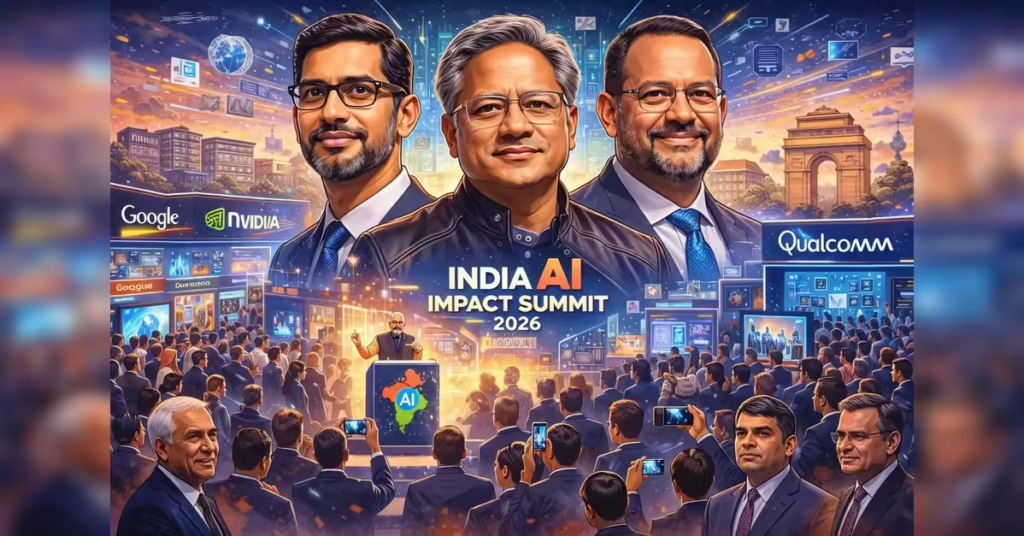
Decoded: A deep dive into the India AI Impact Summit 2026, the $100B “Data-for-Compute” trade, and what the sovereign AI debate means for your future.
By Truthwave Investigation Team | Policy Research Desk | February 11, 2026
The India AI Impact Summit 2026, scheduled for next week in New Delhi, represents the most significant pivot in the Global South’s technological history. As delegations from over 100 nations descend on Bharat Mandapam, the Indian government is positioning the event not just as a conference, but as the operational launchpad for the IndiaAI Mission and a critical node in the global semiconductor ecosystem.
With over 800 million internet users and a digital economy projected to hit $1 trillion, India is the world’s most valuable unrefined data market. MeitY (Ministry of Electronics and IT) has framed the summit as a move toward “Sovereign AI,” aiming to reduce dependency on foreign tech.
But beneath the headlines of “Partnership” and “Progress,” policy analysts warn of a complex negotiation. Is India poised to become an AI superpower, or is it signing a deal that trades long-term digital independence for short-term infrastructure access?
This analysis builds on Truthwave’s ongoing coverage of AI policy and digital rights in India.
Audio Summary
Short Brief
Key Takeaways: The 30-Second Summary
- The Goal: The summit aims to secure $100–150 billion in AI infrastructure investment.
- The Trade-off: Critics warn of a “Data-for-Compute” model where India exchanges public data access for subsidized GPU chips.
- The Job Risk: Entry-level IT and BPO jobs face an “automation cliff” by late 2026 due to agentic AI.
- The Privacy Gap: The DPDP Act contains exemptions that may allow state agencies to bypass consent for “sovereignty” reasons.
- The Alternative: Civil society groups are proposing VISWAM.ai, a “Copyleft” license to keep Indian data open.
In Brief: The India AI Impact Summit 2026
- What: The Global South’s first major multilateral AI summit, focused on “Impact” and development rather than just safety.
- When: February 16–20, 2026.
- Where: Bharat Mandapam, New Delhi.
- Who: Hosted by MeitY; attended by PM Narendra Modi, Sam Altman (OpenAI), Sundar Pichai (Google), and Jensen Huang (Nvidia).
Timeline: How We Got Here (2018–2026)
To understand the stakes, we must look at the evolution of India’s AI strategy:
- 2018: NITI Aayog releases the “National Strategy for AI” (#AIForAll), prioritizing social impact over military use.
- 2022: Launch of Bhashini, a government initiative to build datasets in Indian languages.
- 2023: The DPDP Act is passed, creating a legal framework for data processing.
- 2024: Cabinet approves the ₹10,371 Crore IndiaAI Mission to subsidize computing power for startups.
- 2026: The AI Impact Summit seeks to operationalize these investments by partnering with global tech giants.
The Core Debate: “Data-for-Compute”
The central tension of the summit is economic. While the government highlights the influx of foreign capital, critics point to the “Data-for-Compute” model as a potential sovereignty risk.
The Official Case for Partnership:
India faces a massive infrastructure gap. To build sovereign AI, the nation needs “Compute” (advanced GPU chips like Nvidia’s Blackwell series). Proponents argue that partnering with US firms is the only way to fast-track the semiconductor ecosystem and democratize access for startups.
The Analyst’s Warning:
Silicon Valley is “data-starved.” The western internet has largely been scraped. India offers a fresh, diverse ocean of data (health, finance, language).
The Risk: Developing nations often fall into an “asymmetric dependency”—exporting raw data to train foreign models, only to buy back the finished intelligence as a subscription service. This mirrors the resource extraction models of the colonial era.
Global Context:
- China: Enforces strict data localization policy; foreign models cannot easily access Chinese citizen data.
- EU: The EU AI Act prioritizes citizen rights and strict compliance over rapid deployment.
- India: The summit’s outcome will determine if India leans towards the EU’s protectionism or an open-market “Data Exchange” model.
Key Concept: What is “Sovereign AI”?
The summit’s buzzword is “Sovereign AI.” But what does it actually mean?
| Model | Definition | Examples |
| True Sovereignty | A nation owns the Hardware (Chips), the Data, and the Code. | China (Huawei chips + Baidu models) |
| Strategic Autonomy | A nation owns the Data & Code but relies on foreign Hardware. | France (Mistral AI), UAE (Falcon) |
| The “Tenant” Model | A nation provides Data but relies on foreign Hardware & Models. | Many Global South nations |
Truthwave Analysis: Since India relies heavily on US chips (Nvidia) and US foundation models (OpenAI/Google), experts argue the current strategy is closer to “Strategic Autonomy” than full sovereignty.
Privacy & The DPDP Act: The “State” Loophole
A major pillar of the summit is “Safe and Trusted AI.” The government cites the Digital Personal Data Protection (DPDP) Act 2023 as the safeguard.
The Critique:
Legal experts argue the shield has cracks:
- Section 17 Exemption: The state can exempt government agencies from data processing restrictions for “sovereignty and public order.”
- Surveillance Concerns: Proposals for “context-aware” facial recognition in smart cities raise fears of automated mass surveillance.
The Counter-Balance:
Government officials argue these exemptions are necessary for national security and to prevent the spread of deepfakes, citing the need for rapid intervention capabilities in the new IT Rules 2026.
Student & Job Outlook: The 2026 Micro-Guide
For students and young professionals, the summit presents a double-edged sword. Reports like the Anthropic 2026 Economic Index suggest that “Agentic AI” is beginning to replace entry-level roles in QA Testing and BPO Support.
Future-Proofing Your Career (2026–2030):
- Degrees to Watch:
- AI Ethics & Policy: Demand is spiking for compliance officers to navigate AI governance India regulations.
- VLSI & Hardware Engineering: Essential for the semiconductor mission.
- Skills to Learn:
- Model Fine-Tuning: Specifically for Indian languages (Bhashini architecture).
- System Architecture: Move from “writing code” to “designing systems.”
- Growth Industries:
- Edge AI: Running AI on smartphones/laptops (crucial for India’s mobile-first market).
- Agritech: AI models for crop yield prediction are a major government priority.
The Alternative: VISWAM.ai
Is there a middle path? Digital rights groups and civil society organizations at the summit are circulating a proposal for VISWAM.ai—a “Copyleft” data license.
- The Idea: If a company uses Indian public data to train a model, that specific model must be open-sourced back to the community.
- Status: Currently a policy proposal, not law. However, it represents the primary alternative to the proprietary models pushed by Big Tech.
Conclusion: Predicting the Outcome
The India AI Impact Summit 2026 will likely conclude with massive headline numbers—billions in MoUs and promises of a “Viksit Bharat” (Developed India) powered by AI.
What to Watch (2027–2030):
As we move toward the end of the decade, the key metric will not be investment dollars, but IP ownership. Will the MoUs signed next week allow Indian startups to own the intelligence they build, or will they merely rent it?
India has the data. Silicon Valley has the chips. The summit will decide who holds the power.
Frequently Asked Questions (FAQ)
Q: Why is the India AI Impact Summit 2026 important globally?
A: It is the first time the Global South is hosting a major AI governance summit, shifting the global focus from “existential risk” (Western focus) to “developmental impact” (Global South focus).
Q: How will the India AI Impact Summit affect entry-level jobs?
A: Routine IT and BPO jobs face high risk from automation. However, the summit aims to launch skilling initiatives for new roles in AI maintenance, data curation, and semiconductor engineering.
Q: What is the “Three Sutras” framework in Indian AI policy?
A: It is the government’s ethical framework for AI, focusing on People (Inclusion), Planet (Sustainability), and Progress (Innovation).
Q: Is VISWAM.ai an official government policy?
A: No, VISWAM.ai is currently a proposal by digital rights groups advocated as a “Copyleft” alternative to protect Indian data sovereignty.
Leave a Reply