
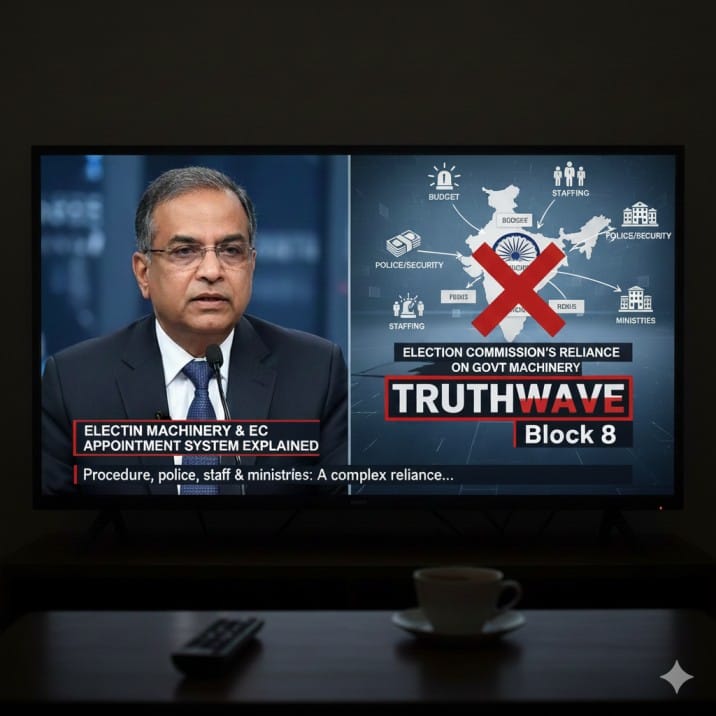
ADMINISTRATIVE DEPENDENCE: WHY THE ECI CANNOT FUNCTION INDEPENDENTLY ON THE GROUND
TruthWave Level-5 Public Investigation | Block 8 of 25
SUMMARY
The Election Commission of India appears powerful, but structurally it depends on the same government it is supposed to regulate. From funding and staffing to police deployment and district administration, the ECI lacks independent control over the machinery required to ensure free and fair elections. Block 8 uncovers the administrative dependencies that weaken India’s election system.
INTRODUCTION — POWER ON PAPER, DEPENDENCE IN REALITY
The Constitution gives the ECI full control over:
- Election scheduling
- MCC enforcement
- Polling processes
- Transfers during elections
- Counting procedures
But in reality, the ECI cannot execute anything without government machinery, because:
ECI has no permanent field staff
ECI does not control its own budget
ECI relies on state officials who fear political retaliation
Police forces answer to state governments
ECI depends on ministries for procurement, transport, security
Election Observers rely on district officers
This creates one of the most dangerous contradictions in Indian democracy:
The institution meant to supervise the government depends on the government for its survival.
TruthWave exposes exactly how this dependency works.
SECTION 1 — BUDGET DEPENDENCE: WHY THE ECI CANNOT FINANCE ITSELF
India’s Election Commission does not have an independent financial system.
It cannot:
- Approve its own budget
- Request funds directly from Parliament
- Purchase equipment freely
- Hire independent staff directly
Instead:
Budget approvals come through the Ministry of Law & Justice
Procurement passes through government systems
Financial proposals require executive approval
Source (ECI & MoLJ documentation):
https://lawmin.gov.in
https://eci.gov.in
TruthWave Commentary
An institution that must ask the government for money
cannot fully regulate the government during elections.
This financial dependence acts as a soft pressure mechanism.
SECTION 2 — MANPOWER DEPENDENCE: NO OWN STAFF, ONLY BORROWED STAFF
ECI does not have its own election workforce.
Instead, it uses:
- State civil servants
- District administration
- Teachers
- Clerks
- Local government employees
- State police
This creates serious risks:
Officers fear political retaliation after elections
Transfers are controlled by state governments
Election-time neutrality cannot be guaranteed
MCC violations might go unreported
Case Study (Block 5):
A DM said:
“If we act against a candidate today,
tomorrow he could be a minister.”
TruthWave Commentary
No referee can be neutral
when the players control their salary, career, and transfers.
SECTION 3 — POLICE DEPENDENCE: SECURITY IS NOT IN ECI’S CONTROL
Election security requires:
- Local police
- State police
- Central Armed Police Forces (CAPF)
- Intelligence units
But:
ECI does not command the police force
State police remain under state governments
CAPF deployment depends on Home Ministry coordination
This affects:
- Booth security
- Voter intimidation
- Violence control
- Sensitive area monitoring
Case Study (Bengal):
Retired IPS officer noted political influence in force deployment
(covered in Block 5).
TruthWave Commentary
A referee cannot enforce rules
when the security guards answer to the players—not the referee.
SECTION 4 — LAW MINISTRY CONTROL: THE INVISIBLE CHAIN
The Ministry of Law & Justice functions as the administrative ministry for the ECI.
This means:
- Legal matters
- Budget files
- Staff approvals
- Infrastructure proposals
- Administrative support
all pass through the executive branch of government.
This gives the government enormous indirect influence.
Supreme Court also flagged this vulnerability during hearings.
TruthWave Commentary
If the ECI must function through the government’s administrative ministry,
its independence is inevitably compromised.
The referee’s office is inside the locker room of one team.
SECTION 5 — DEPENDENCE ON STATE ADMINISTRATION: THE CORE WEAKNESS
During elections, the ECI “takes control” of:
- District Collectors
- SPs
- ROs
- AROs
- Tehsildars
- Local monitoring teams
But this control is:
Temporary
Instructional, not structural
Dependent on cooperation
Easily resisted after elections
Case Study:
An Observer said:
“We see only what district officers want us to see.”
This shows that ECI cannot fully supervise administrative machinery.
TruthWave Commentary
Temporary authority is not true authority.
When ECI borrows the government’s staff,
it inherits the government’s biases.
SECTION 6 — TRANSFER POLITICS: THE ECI’S TOOL THAT CAN BACKFIRE
ECI is known for transferring officers rapidly before elections.
But:
- These officers return to the same states after elections
- Their careers depend on political goodwill
- Officers can resist or delay implementation
- Some transfers are symbolic, not effective
Case Studies (Tamil Nadu, UP, Telangana):
Parties accused ECI of selective transfers
(Block 2 & Block 5 references)
TruthWave Commentary
A transfer order can move a person—
but it cannot change a system.
SECTION 7 — TECHNOLOGY DEPENDENCE: EVM & VVPAT SUPPLY CHAIN
EVMs and VVPATs are manufactured by:
- BEL (Bharat Electronics Ltd.) — under Defence Ministry
- ECIL (Electronics Corporation of India Ltd.) — under DoDP
This means:
ECI does not own the technology
ECI cannot independently audit the machines
ECI depends on government-controlled PSUs
This creates trust gaps.
TruthWave Commentary
When election technology is not under the Commission’s independent control,
the perception of neutrality becomes vulnerable.
Trust is not just about accuracy—it is about independence.
SECTION 8 — WHY ADMINISTRATIVE DEPENDENCE MATTERS
This dependence creates:
Soft pressure
Fear of state retaliation
Delayed decisions
Weak MCC enforcement
Unequal playing field
Confusion during turnout reporting
Inconsistency in observer reports
Slow action against violations
The ECI is constitutionally mighty,
but administratively fragile.
TruthWave Commentary
An institution’s strength is measured not by its paper powers,
but by its freedom to use those powers.
The ECI has power.
It does not have operational freedom.
CONTINUE TO BLOCK 9
Block 9 exposes technology, EVM/VVPAT concerns, supply chain dependencies, lack of audits, global comparisons, and transparency issues.
This is one of the most highly-requested blocks.