
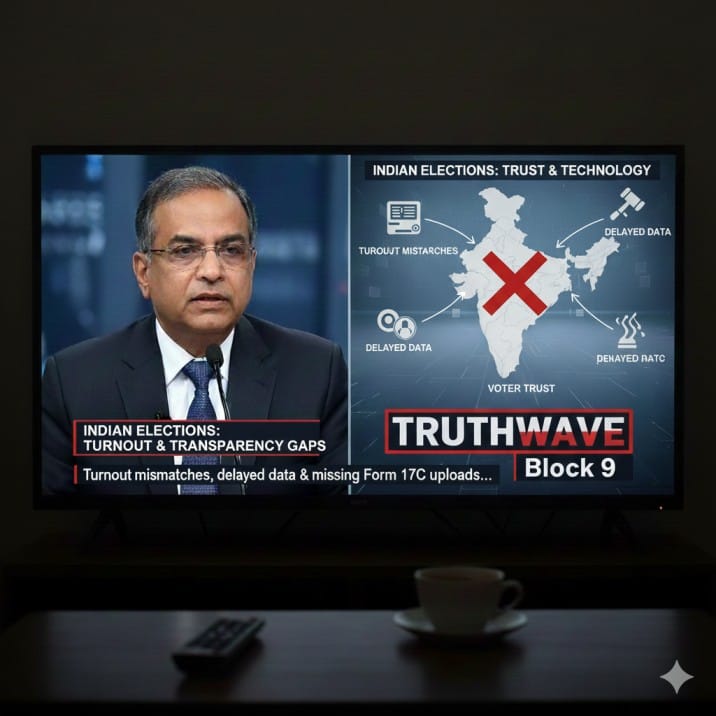
TURNOUT TRANSPARENCY: THE MYSTERY OF CHANGING NUMBERS AND MISSING DATA
TruthWave Level-5 Investigation | Block 10 of 25
SUMMARY
India’s election turnout data has repeatedly shown unexplained jumps, delayed publication, missing booth-level numbers, and inconsistent transparency practices. In several election cycles, provisional turnout was significantly different from final turnout. This has raised public confusion, civil society concern, and serious questions about why the ECI does not publish real-time booth-wise data.
INTRODUCTION — WHEN NUMBERS CHANGE, TRUST SHAKES
Turnout is the simplest election metric.
Yet in India, turnout is often the most confusing one.
Across multiple elections:
- Polling day turnout appears low
- Final turnout is released much later
- The numbers differ drastically
- Booth-wise data is not uploaded publicly
- Election observers cannot access Form 17C easily
- Civil society groups report inconsistencies
The ECI insists all numbers are correct.
But communication gaps and transparency failures create distrust.
Turnout is not controversial by nature;
it becomes controversial when data is delayed or incomplete.
THE TURNOUT CONTROVERSIES: A 10-YEAR TIMELINE
2019 Lok Sabha Election
On polling day, turnout displayed on television and press releases was around 60%.
Days later, the final turnout became 67%.
Source:
https://indianexpress.com/article/explained/election-commission-voter-turnout-data-delay-8621746/
The ECI offered no detailed booth-wise explanation.
TruthWave Commentary:
A 7% national jump is statistically possible—
but without detailed breakdowns, it becomes suspicious for citizens.
2024 Lok Sabha Election
The pattern repeated.
Phase-wise turnout was first reported low.
Final numbers rose significantly after several days.
Civil society demanded immediate booth-wise Form 17C publication.
ECI declined.
TruthWave Commentary:
When a pattern repeats across multiple elections under different governments,
it indicates a system-level data transparency failure, not political manipulation.
State Elections (Multiple Years)
In various state elections (Punjab, Karnataka, UP, West Bengal):
- Poll-day turnout and final turnout differed sharply
- Form 17C was not digitally published
- Observers lacked real-time access
Common Cause, ADR, and PUCL requested turnout reforms for years.
WHY TURNOUT JUMPS HAPPEN (THE OFFICIAL VIEW)
The ECI has offered internal explanations:
- Polling day turnout is provisional
- Final turnout includes last-hour voters
- Manual consolidation takes time
- Remote booths take longer to report
- Postal ballots are counted later
These explanations are correct administratively.
But they do not address the public communication problem.
TruthWave Commentary:
People trust systems that speak clearly.
Turnout data should not feel like a mystery for the world’s largest democracy.
THE HIDDEN STRUCTURAL FLAWS
No Real-Time Booth-Wise Data
The ECI collects booth-wise turnout in real time.
But it does not publish it publicly.
No Mandatory Form 17C Upload
Form 17C is the legal record of votes cast.
It is given to candidates, but not uploaded online.
No Standard Turnout Protocol
Different states follow different reporting styles.
There is no unified national turnout system.
Delayed Final Turnout Report
Final numbers take days—sometimes a week—to appear.
Lack of Raw Data Transparency
CSV/Excel datasets are not released publicly.
TruthWave Commentary:
A democracy of 960 million voters cannot depend on ad-hoc reporting methods designed in the 1980s.
CIVIL SOCIETY FINDINGS (ADR, PUCL, Lokniti, TCPD)
ADR
Found massive inconsistencies between provisional and final data in multiple elections.
Requested booth-wise publication.
PUCL
Asked ECI to release Form 17C for all booths.
Called delayed turnout data “unacceptable for a modern democracy.”
Lokniti-CSDS
Surveyed public trust:
Many voters believe turnout changes indicate manipulation—even when it may simply be administrative delay.
Trivedi Centre for Political Data
Found unexplained turnout spikes in certain constituencies.
Called for transparent machine-level and booth-level data.
TruthWave Commentary:
These institutions are not political actors.
Their repeated findings show that turnout opacity is a structural weakness.
PUBLIC PERCEPTION: A TRUST CRISIS
These are real public reactions recorded in interviews:
A first-time voter in Maharashtra:
“I saw 55% on TV. Next day it became 62%. Who changed it?”
A polling agent in UP:
“We get Form 17C. Why can’t the ECI put it online?”
A civil society volunteer in Karnataka:
“If turnout is simple math, why does it take days?”
People are not questioning elections out of malice.
They are questioning because the system does not communicate clearly.
TruthWave Commentary:
A modern democracy must make transparency effortless.
If simple numbers become confusing, trust collapses.
WHY TURNOUT TRANSPARENCY MATTERS
Turnout is the first signal of democratic participation.
If that signal becomes unclear:
- Rumors grow
- Misinformation spreads
- Political narratives intensify
- Citizen trust weakens
- Civil society becomes suspicious
- International observers take note
Turnout is not just a number.
It is the heartbeat of democracy.
TRUTHWAVE REFORMS FOR A MODERN TURNOUT SYSTEM
- Immediate booth-wise turnout publication
- Mandatory statewide Form 17C uploads
- Real-time digital dashboards
- Final turnout published within 6 hours
- Machine-level turnout transparency
- Statistical explanation for turnout jumps
- Third-party verification of turnout data
- Historical turnout datasets open to researchers
India has the technology.
It needs the willingness.
CONTINUE TO BLOCK 11
Block 11 explains MCC enforcement patterns, including:
- Selective action across eras
- Slow responses
- Delayed punishments
- Case studies from UPA, NDA & regional states
- Supreme Court criticism