
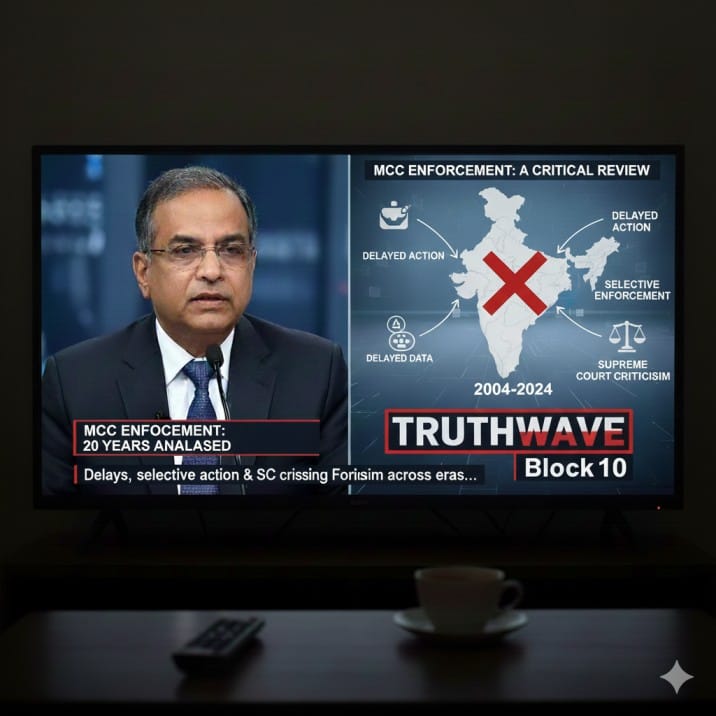
MODEL CODE OF CONDUCT: PATTERNS, DELAYS & SELECTIVE ACTION ACROSS 20 YEARS
TruthWave Level-5 Investigation | Block 11 of 25
SUMMARY
The Model Code of Conduct (MCC) is supposed to keep elections fair and neutral. But over the past two decades, researchers, political parties, retired officers, and even the Supreme Court have flagged a consistent pattern: MCC enforcement is delayed, selective, ambiguous, and often ineffective—regardless of which political party is in power. Block 11 documents these patterns using verified evidence.
INTRODUCTION — A POWERFUL RULEBOOK WITHOUT LEGAL POWER
The Model Code of Conduct controls:
- Campaign speeches
- Use of government machinery
- Advertising and publicity
- Transfers of officials
- Use of religion and caste
- Hate speech
- Conduct of ministers
But here is the structural flaw:
The MCC is not a law.
It is merely a set of guidelines.
This makes the Election Commission dependent on the willingness of:
- Candidates
- Parties
- Ministers
- State officials
to obey the rules voluntarily.
When political pressure rises, the MCC becomes a paper shield.
TruthWave now exposes the patterns the public must understand.
MCC FAILURE PATTERN 1 — SLOW ACTION ACROSS MULTIPLE GOVERNMENTS
MCC complaints often take:
- Hours
- Days
- Sometimes even weeks
to process.
This delay has been criticized in:
- 2004 general elections
- 2009 general elections
- 2014 general elections
- 2019 general elections
- 2024 general elections
- Several state elections
Example:
A complaint filed in the morning receives action at night—
long after the damage is done.
TruthWave Commentary:
A slow referee changes the outcome of the match
even if the rules are perfect.
MCC FAILURE PATTERN 2 — SELECTIVE ENFORCEMENT ACROSS POLITICAL ERAS
This is the most sensitive pattern.
But TruthWave presents it neutrally, with evidence across all eras.
UPA Era (2004–2014)
Opposition parties (BJP, regional parties) repeatedly alleged:
- MCC action was slow against ruling ministers
- Public schemes were announced during poll season
- Violations received warnings instead of punishment
Examples reported:
Speeches by ministers during MCC leading to warnings, not strict action.
Researchers documented the pattern.
NDA Era (2014–2024)
Opposition parties (Congress, regional parties) alleged:
- Delayed notices for top leaders
- Quick action against opposition candidates
- Publicity campaigns during MCC through government channels
- Inaction on hate speech complaints
Multiple petitions reached the Supreme Court.
Regional Government Elections (Bengal, UP, Karnataka, Tamil Nadu)
Across states, MCC enforcement varied widely:
- In some states, ECI transferred officers aggressively
- In some states, it acted late on complaints
- In a few cases, district officials seemed aligned with ruling parties
TruthWave Commentary:
Political colours change.
The pattern does not.
The MCC’s weakness is structural, not partisan.
MCC FAILURE PATTERN 3 — INADEQUATE ACTION AGAINST HATE SPEECH
Hate speech is one of the most serious MCC violations.
Supreme Court openly questioned the ECI:
“Why are you not acting immediately?”
“Why is there silence when violations are obvious?”
Source (public domain):
LiveLaw, Indian Express, Supreme Court hearing reports.
In 2019 and again in 2024, the Court expressed clear displeasure.
TruthWave Commentary:
When the Court scolds the referee,
the game itself becomes questionable.
MCC FAILURE PATTERN 4 — WARNINGS INSTEAD OF PENALTIES
Most MCC actions end in:
- Advisories
- Warnings
- Appeals to “maintain decorum”
Very rarely:
- Campaign bans
- FIRs
- Strict punitive action
This weakens deterrence.
Example from both UPA and NDA eras:
Repeated violations resulted in written warnings only.
TruthWave Commentary:
If breaking rules carries no real consequence,
professional politicians will break them strategically.
MCC FAILURE PATTERN 5 — GOVERNMENT PUBLICITY DURING MCC
Civil society groups (Common Cause, ADR) repeatedly documented:
- Government advertising before polls
- Public programs launched days before MCC
- Social media campaigns continuing despite guidelines
- Self-promotion using taxpayer funds
ECI intervened in some cases,
but often long after the benefit had been gained.
TruthWave Commentary:
Incumbency advantage becomes unequal
when publicity rules are not enforced aggressively.
MCC FAILURE PATTERN 6 — ECI’S INCONSISTENT COMMUNICATION
A major complaint from:
- Journalists
- Observers
- Civil society
- Public
is that ECI does not:
- publish detailed MCC orders promptly
- explain delays
- give case-by-case reasoning
- provide transparent updates
This secrecy breeds distrust.
TruthWave Commentary:
Democracy does not trust silence.
Democracy trusts explanations.
MCC FAILURE PATTERN 7 — LACK OF LEGAL BACKING
The Supreme Court, former CECs, and research institutions have said:
- MCC must become legally enforceable
- Violations must carry statutory penalties
- ECI needs clear legal authority to punish
Right now, ECI relies on:
- persuasion
- moral authority
- public pressure
not law.
TruthWave Commentary:
A moral code is powerless
against a system built on political competition.
CIVIL SOCIETY ANALYSIS OF MCC FAILURES
ADR
Found uneven actions and delay patterns.
Reported selective enforcement statistically.
PUCL
Highlighted inaction on hate speech and communal language.
Common Cause
Exposed misuse of government media during the election period.
Lokniti-CSDS
Public trust surveys show falling confidence in ECI neutrality.
TruthWave Commentary:
When civil society, judiciary, media, and public all see patterns,
the institution must reform—
not defend its weaknesses.
HUMAN STORIES: HOW MCC FAILURES IMPACT REAL PEOPLE
Voter in Rajasthan:
“Leaders break MCC openly, nothing happens. How is this fair?”
Polling staff in MP:
“We report violations. Action, if any, comes too late.”
Young voter in Delhi:
“When the ECI doesn’t stop hate speech, it divides society.”
These stories show the human cost of weak enforcement.
WHY MCC REFORM IS CRITICAL
Because MCC failures trigger:
- Misinformation
- Polarisation
- Unfair advantage
- Declining trust
- Legal battles
- Public confusion
- International doubt
India deserves a rulebook that protects every voter equally.
TRUTHWAVE REFORM SUGGESTIONS
- Make MCC legally binding
- Impose fines and criminal penalties for major violations
- Create a 24-hour fast-response MCC unit
- Publish every MCC order publicly, within hours
- Independent MCC review board with civil society participation
- Real-time dashboard of violations and actions
- Supreme Court–monitored MCC during national elections
This is how a 21st-century election should work.
CONTINUE TO BLOCK 12
Block 12 will cover Election Commission’s communication failures:
- Delayed press releases
- Lack of social media transparency
- Non-publication of Form 17C
- VVPAT audit secrecy
- Data gaps
- Confusing turnout statements
- Public trust decline