
TruthWave Level-5 Public Investigation | Block 3 of 25
SUMMARY
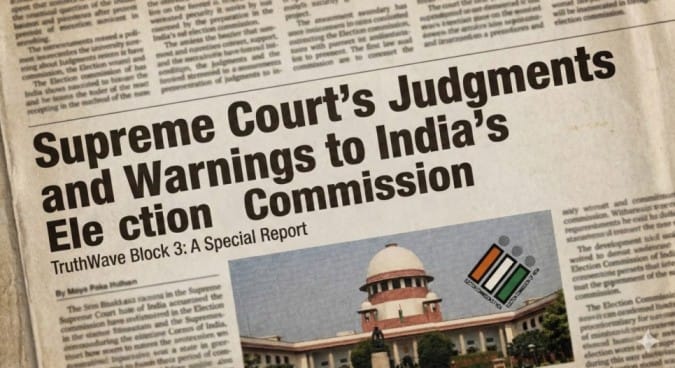
For four decades, India’s Supreme Court has repeatedly warned that the Election Commission’s independence is weakening. Through landmark judgments, sharp questions, and rare public rebukes, the Court has built a paper trail showing structural vulnerabilities that threaten the integrity of Indian elections. Block 3 documents those warnings in simple public language—something no mainstream newsroom has done.
INTRODUCTION — WHEN THE COURT SPEAKS, A COUNTRY MUST LISTEN
India’s Supreme Court is the final guardian of the Constitution.
But when the Court itself begins issuing warnings about the Election Commission of India (ECI)—the referee of democracy—the message is serious:
“Your democratic machinery is under strain.”
“Your election system is vulnerable.”
“Your institutions are not keeping pace with political pressure.”
TruthWave has collected 40 years of Supreme Court remarks, judgments, questions, and concerns—
and translated them into language the public can finally understand.
No legal jargon.
No academic fog.
Only truth.
SECTION 1 — THE 1978 WARNING THAT STILL DEFINES INDIAN DEMOCRACY
Case 1: Mohinder Singh Gill vs Chief Election Commissioner (1978)
Source:
(https://indiankanoon.org/doc/901440/)
This judgment is the origin story of India’s election jurisprudence.
The Supreme Court declared:
“Free and fair elections are part of the Basic Structure of the Constitution.”
This means elections are untouchable, even by Parliament.
The Court also said the ECI must act with:
- Independence
- Boldness
- Neutrality
- Constitutional duty
- Integrity beyond politics
TruthWave Commentary:
This case gave India a moral compass,
but not an institutional shield.
We protected the idea of independence,
but not the structure that ensures independence.
This gap between principle and protection haunts India even today.
SECTION 2 — THE ERA OF TRANSPARENCY BEGINS (2013)
Case 2: NOTA Judgment — PUCL vs Union of India (2013)
Source:
(https://indiankanoon.org/doc/11081311/)
The Court introduced NOTA—None of the Above.
Why?
To empower the voter.
A powerful line from the judgment:
“Democracy thrives when voters are given a choice to reject.”
TruthWave Commentary:
The Court modernised democracy.
But NOTA exposed a hidden reality:
Indian elections were expanding in power,
but the institutions managing elections were not expanding in capability.
The voter evolved.
The ECI did not evolve fast enough.
SECTION 3 — PAPER TRAILS AND TECHNOLOGY FEARS (2013–2019)
Case 3: VVPAT Paper Trail Case
Subramanian Swamy vs Election Commission
Source:
(https://indiankanoon.org/doc/102317645/)
The Court forced the ECI to introduce VVPAT:
“A paper audit trail is indispensable for the satisfaction of all stakeholders.”
Before this, the ECI resisted VVPAT citing “cost” and “practicality.”
The Court did not accept that excuse.
TruthWave Commentary:
If technology is used for elections,
technology must work for transparency, not against it.
But even today:
- Only a tiny fraction of VVPAT slips are counted
- No independent audit is allowed
- Public understanding remains low
The Supreme Court laid the foundation.
But ECI built the house only halfway.
SECTION 4 — THE COURT REBUKES ECI FOR SILENCE (2019–2024)
Case 4: Hate Speech PILs and the “Silent Spectator” Comment
Source:
(https://www.livelaw.in/top-stories/supreme-court-ec-hate-speech-233014)
During election seasons, political speeches often violate the Model Code of Conduct (MCC).
Opposition parties claimed the ECI was too slow or too soft.
The Supreme Court asked directly:
“Why are you not acting? Why are you silent?”
This was a public reprimand, not hidden in legal language.
TruthWave Commentary:
This was historic.
It showed that India’s most powerful court believed the ECI wasn’t exercising its full authority.
When the referee refuses to blow the whistle,
players stop respecting the rules.
SECTION 5 — THE APPOINTMENT SYSTEM THAT BROKE THE TRUST (2023)
Case 5: Anoop Baranwal vs Union of India (2023)
Source:
(https://main.sci.gov.in/supremecourt/2021/35064/35064_2021_1_1501_41441_Judgement_02-Mar-2023.pdf)
This case struck at the heart of the ECI’s structural weakness.
For decades, the executive (ruling government) controlled the appointment of:
- Election Commissioners
- Chief Election Commissioner
The Court declared:
“Appointments only by the executive are unconstitutional.”
It recommended a three-member committee:
- Prime Minister
- Leader of Opposition
- Chief Justice of India
This created public hope.
But Parliament soon passed a law removing the Chief Justice from the panel.
TruthWave Commentary:
This is one of the biggest red flags in India’s democratic history.
The Court tried to increase independence.
The political system neutralised it.
This shows that institutional reform cannot depend on goodwill—it must be protected by design.
SECTION 6 — THE ELECTORAL BONDS EXPLOSION (2024)
Case 6: Electoral Bonds Judgment (2024)
Source:
(https://main.sci.gov.in/supremecourt/2021/35064/35064_2021_1_1501_41441_Judgement_15-Feb-2024.pdf)
The Supreme Court struck down the Electoral Bonds Scheme as unconstitutional.
The shock came when the Court revealed:
The ECI had written privately to the government warning about opacity.
But the public NEVER heard this from the ECI.
TruthWave Commentary:
When the ECI fears speaking publicly,
it signals institutional insecurity.
The referee should never whisper truth in private
and remain silent in public.
This is how institutions slowly bend.
SECTION 7 — SMALL BUT IMPORTANT SC OBSERVATIONS (1990–2024)
Below are smaller but important judicial comments over the years:
“ECI must be fearless.”
“ECI must act even against the powerful.”
“ECI must ensure level playing field.”
“ECI must publish data clearly.”
“ECI must not delay transparency.”
Each of these remarks came in different hearings across decades.
TruthWave Commentary:
These repeated warnings show the same truth:
The judiciary sees structural weakness inside the ECI that political systems refuse to fix.
India is running a 21st-century election
with a 20th-century institutional design.
SECTION 8 — WHAT THE SUPREME COURT NEVER SAID BUT ALWAYS MEANT
Across all judgments, one message is consistent:
An Election Commission dependent on political executives is dangerous for democracy.
The Supreme Court did not use the word “capture.”
But its concerns pointed clearly in that direction.
TruthWave Commentary (Youth Message):
The next generation must understand:
Institutions rarely fail dramatically.
They fail slowly, silently, through:
- appointment control
- administrative dependence
- lack of transparency
- absence of public courage
Democracy is not protected by slogans.
It is protected by independent referees.
CONTINUE TO BLOCK 4
Block 4 exposes what former Chief Election Commissioners and Election Commissioners have publicly said about:
- Pressure from ruling governments
- Attempts to influence decisions
- Threats to independence
- Internal disagreements
- Resignations and protest letters
- Cases where Commissioners refused to sign decisions
This is one of the most revealing blocks.