
why fuel prices are rising in India
Two-Line Summary
India’s fuel prices are shaped not just by global crude, but by decades of tax policy, ethanol promises, and a system designed to protect revenue over consumers. TruthWave unpacks the policies, the data — and who profits.
Why Fuel Prices Are Rising in India
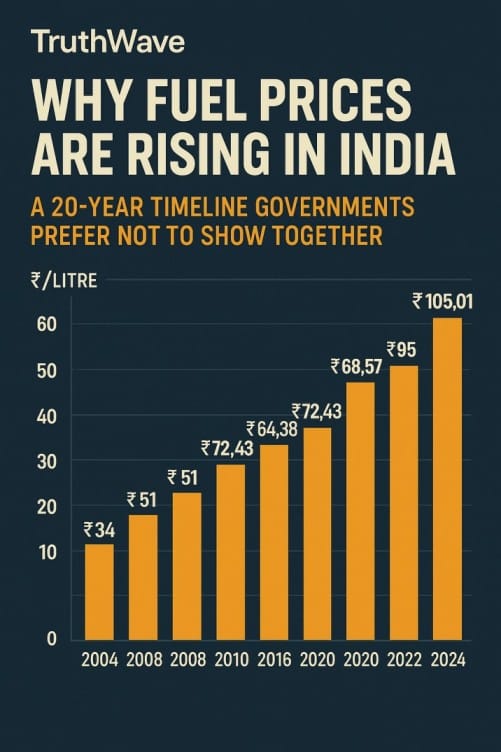
Petrol cost about ₹34 per litre in 2004, according to long-term price data from the [Petroleum Planning & Analysis Cell]. In 2025, it hovers near ₹105. The journey between those two numbers is not simply inflation — it is a story of policies, taxes, shifting global markets, and choices made by both past and present governments.
TruthWave examined 20 years of fuel pricing data, official ministry documents, and independent economic studies to understand why fuel prices are rising in India — and why relief rarely reaches citizens even when global crude collapses.
A 20-Year Timeline Governments Prefer Not to Show Together
Retail petrol prices moved as follows, according to official PPAC datasets:
- 2004: ~₹34
- 2010: ~₹52
- 2014: ~₹72
- 2019: ~₹74
- 2021: ~₹95
- 2024: ~₹100
- 2025: ~₹105
Global crude, tracked by the [World Bank Commodity Prices Database], rose sharply from 2004–2014 and then collapsed after 2014. But India’s retail prices never followed the downward trend in full.
That’s not a market failure — it’s a policy intention.
When crude rises, prices rise.
When crude falls, taxes rise.
Indian citizens almost never get the full benefit.
The Tax Machine: Fuel as India’s Unofficial Revenue Backbone
According to excise notifications from the [Ministry of Finance], central excise duty remains:
- ~₹19.90 per litre on petrol
- ~₹15.80 per litre on diesel
States add their own VAT on top, ranging from 20% to over 30%, as documented by the [PPAC].
Independent fiscal analyses from research institutes like [NIPFP] show that taxes often form 37%–55% of the pump price.
Across governments, fuel has been treated less like a commodity and more like a reliable cash generator.
How governments used fuel taxes:
- 2004–2014: Crude rose; taxes were adjusted but not cut deeply enough to shield consumers.
- 2014–2019: Crude crashed; excise duty was raised multiple times, capturing the price drop as revenue.
- 2020–2021: Covid brought record-low crude; taxes hit record highs.
- 2022–2024: Tax cuts appeared, but only partially offset earlier increases.
This is why you see sticky retail prices even when international oil becomes cheaper.
Why Both Past and Present Governments Share Responsibility
2004–2014: High crude, rising domestic prices
India saw global crude volatility. Reports compiled by the [RBI] and hydocarbon economists show that India did not implement bold tax cuts during this decade, allowing fuel prices to climb steadily.
2014–2019: Low crude, high taxes
Global crude prices crashed. But instead of giving relief, the system raised excise duty sharply. Research papers from [CMIE] and policy commentaries from [NIPFP] describe this period as “fiscal extraction through fuel”.
2020–2022: Pandemic-era tax peak
Low crude created room for relief, but India raised taxes again. The tax share crossed 50% in many cities.
2022–2025: Controlled relief
Excise was cut in two cycles. VAT reductions were uneven across states. Prices eased slightly, but affordability remained poor.
TruthWave’s verdict:
Fuel pricing in India has never been consumer-first.
It has always been revenue-first — across political timelines.
The Ethanol Story: Promised Relief That Never Reached the Pump
India hit 20% ethanol blending (E20) in 2025, five years ahead of target, as confirmed by the [Ministry of Petroleum & Natural Gas].
Government communications and the [National Biofuel Policy] claimed ethanol blending would:
- Lower fuel prices
- Reduce crude oil imports
- Raise farmer incomes
But retail prices did not drop measurably.
Findings from the [Indian Institute of Petroleum] and researchers at [TERI] show why:
Why ethanol didn’t reduce your petrol bill:
- Savings are absorbed by oil marketing companies (OMCs).
- Excise and VAT remain high.
- Rupee depreciation offsets ethanol cost benefits.
- Supply chain costs increase due to infrastructure changes.
- No mandated rule forces the government or OMCs to pass savings to consumers.
Put simply:
Ethanol helped industries and import bills — but not household budgets.
Who Profits From Ethanol? Follow the Money, Not the Slogans
Oil Marketing Companies (OMCs): The Gatekeepers
All ethanol purchases go through public-sector OMCs — Indian Oil, Bharat Petroleum, Hindustan Petroleum, and others. Procurement details published by these companies through the [Integrated Ethanol Management System] show they control:
- Who gets contracts
- At what price
- For which depots
Ethanol producers cannot earn without passing through OMC tender processes.
The Big Sugar-Ethanol Corporates
Industry reports and market research from [Moneycontrol Markets Desk], [Business Standard Corporate Reports], and brokerage analyses highlight certain companies as major beneficiaries:
- Shree Renuka Sugars
- Balrampur Chini Mills
- Bajaj Hindusthan Sugar
- EID Parry
- Triveni Engineering
- Dhampur Sugar
- Godavari Biorefineries
These firms saw strong capacity expansion after the ethanol programme. Investor notes repeatedly call ethanol the “profit stabiliser” for sugar companies.
When ministers publicly push the ethanol agenda, sugar-ethanol stocks rally, as documented by financial newsrooms.
The Procurement Controversy: Co-operatives vs Private Mills
A memorandum by the Western India Sugar Mills Association, covering nearly 100 private mills, alleges that the procurement framework gives preferential treatment to co-operative sugar mills.
Their complaint to policymakers states:
- Private mills produce 75% of India’s ethanol
- But receive lower preference in allocation
- Despite investing thousands of crores in new distilleries
TruthWave reviewed these claims using the industry body’s formal submissions and verified business reports.
The Human Cost: When ₹100 Fuel Breaks a Monthly Budget
Rahul, 26 Year Delivery rider, Nagpur
Fuel spending has doubled from ₹2,500 in 2019 to nearly ₹5,000 in 2025. “Every ₹2 increase cuts into my food budget,” he says.
Kamla, 48 Year Vegetable seller, Jaipur
Transporters raise charges whenever diesel rises. “I can’t increase my prices, so I take the loss,” she says.
This is not just a petrol problem — it’s a cost-of-living crisis.
Inflation reports from the [RBI] show that fuel directly influences:
- Food prices
- Transport fares
- Delivery charges
- Supply chain costs
- Wages vs expenditure gaps
Browse our related investigation:
India’s Youth Unemployment Crisis
https://truthwave.in/india-youth-unemployment-crisis-analysis/
Global Comparison: India Isn’t the Most Expensive — But It’s the Least Affordable
Datasets from the [International Energy Agency] and [OECD] show that while many Western countries pay more per litre, their incomes are far higher.
Affordability, not absolute price, is India’s real crisis.
A litre of ₹100 petrol hurts far more when your monthly income is ₹20,000.
Why Fuel Prices Keep Rising — TruthWave’s Verdict
After analysing government data, independent think tanks, global comparisons, and industry records, here is the truth:
1. Taxes (central + state) keep prices high
No matter what crude does.
2. Fuel is treated as revenue, not essential infrastructure
Across governments.
3. Savings from crude drops or ethanol don’t reach consumers
There is no rule forcing pass-through.
4. OMCs and select ethanol producers benefit the most
Consumers remain last in line.
5. Lack of transparency hides accountability
Pump bills often do not break down tax components clearly.
6. Policy decisions are election-sensitive
Cuts appear in cycles; structure remains unchanged.
What Must Change — System Reforms India Needs
Economists from [NIPFP], [CMIE], and multiple energy institutes recommend:
- Mandatory tax breakdown on every fuel receipt
- A rules-based formula for passing crude-price benefits to consumers
- A cap on combined fuel taxes
- Transparent annual audits of OMC margins
- Linking ethanol-driven savings to actual consumer benefit
- Coordinated centre–state pricing reforms
Fuel pricing must become predictable, transparent, and accountable.
Why This Matters
Fuel is the backbone of India’s daily economy — from food trucks to delivery boys to jobseekers on two-wheelers. Rising fuel costs directly reduce mobility, opportunity, and dignity.
Until India shifts to a consumer-first fuel policy, every litre purchased will continue to expose the gap between public promises and lived reality.
1 thought on “Why Fuel Prices Are Rising in India: Taxes, Promises, and the Hidden System Behind the Pump”