Technology, Transparency, and the Limits of Trust in India’s Election System
By idmahamad sekh
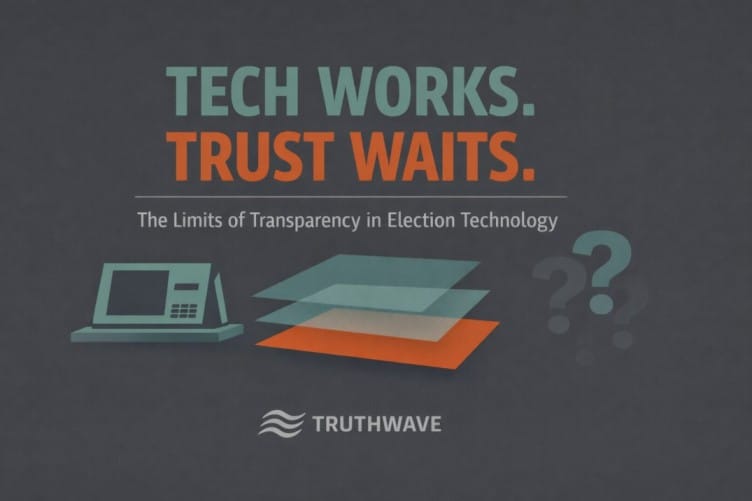
TruthWave Level-5 Public Investigation | Block 19 of 25
Technology, Transparency, and the Limits of Trust in India’s Election System
SUMMARY
Election technology in India—especially EVMs, VVPATs, and digital processes—was introduced to enhance efficiency and integrity. However, technology alone cannot generate trust. Block 19 examines how transparency gaps, limited public understanding, and restricted auditability have placed natural limits on how much confidence technology can create in India’s election system.
INTRODUCTION — TECHNOLOGY IS A TOOL, NOT A GUARANTEE
Technology can speed up processes, reduce human error, and standardize procedures.
But trust in elections does not arise from machines alone. It depends on whether citizens can understand, verify, and question how those machines operate. In India, technological adoption has often moved faster than public transparency.
This block explores why trust has limits when transparency does not keep pace with technology.
THE PROMISE OF ELECTION TECHNOLOGY
India adopted electronic voting to:
- Reduce booth capture
- Eliminate invalid ballots
- Speed up counting
- Standardize voting across regions
These objectives were largely achieved at a procedural level.
THE TRANSPARENCY GAP
Despite operational success, several transparency limits persist:
- Technical audits are not fully public
- Source code is not independently accessible
- Verification processes are complex and poorly explained
- Public demonstrations reach limited audiences
For many voters, the system works—but how it works remains opaque.
VVPAT: ASSURANCE WITH LIMITS
VVPATs were introduced to increase confidence by allowing voters to verify their vote.
However:
- Only a small number of VVPAT slips are counted
- Full audit trails are not conducted
- Selection processes are not widely understood
This creates reassurance without full verifiability.
Source:
Election Commission of India
https://eci.gov.in
COMMUNICATION VS TECHNICAL DETAIL
Institutions often rely on:
- Technical explanations
- Legal assurances
- Expert statements
But trust requires:
- Simple explanations
- Visual clarity
- Independent verification pathways
Without this, complexity itself becomes a barrier.
JUDICIAL BALANCING OF TECHNOLOGY AND TRUST
Courts have acknowledged both:
- The necessity of technology
- The need for public confidence
Judicial interventions increased transparency requirements incrementally, but avoided mandates that could disrupt election logistics.
Source:
Supreme Court of India
https://main.sci.gov.in
PEOPLE’S IMPACT
A voter from Hyderabad expressed the common dilemma:
“I believe the system works. But I don’t know how to prove it to myself.”
This is not rejection—it is conditional trust.
THE STRUCTURAL CONSEQUENCE
Limited transparency produces:
- Persistent suspicion
- Recurring litigation
- Polarized narratives
Even when evidence of failure is absent.
WHAT THIS DOES NOT CLAIM
This investigation does not claim technological manipulation or malfunction.
It examines how trust cannot grow beyond transparency, regardless of performance.
WHY THIS MATTERS
Elections require belief, not just accuracy.
When technology advances faster than understanding, trust plateaus.
TRUTHWAVE FINDING
India’s election technology has improved efficiency.
Its transparency mechanisms have not expanded at the same pace.
Trust, therefore, remains bounded by what citizens can see and verify.
For context on how institutional signals affect voter confidence, see TruthWave Block 18: Youth and First-Time Voters.
LEGAL-SAFETY NOTE
This investigation examines institutional systems and publicly available data. It does not allege individual wrongdoing.
Continue to Block 20:
Who benefits from delayed reform and institutional opacity.
Leave a Reply