Skip to content
TruthWave india

TruthWave india

Truth Before Power

  • india
  • Public Services
  • Terms of Service
  • Privacy Policy
  • About TruthWave
  • Disclaimer
  • Toggle search form
  • Rainy Kolkata street representing West Bengal monsoon weather
    পশ্চিমবঙ্গে ২২-২৬ সেপ্টেম্বর ভারী বৃষ্টির সম্ভাবনা: জেলা ও করণীয় Jobs
  • Investigation: EVM Totaliser Debate Puts Voter Privacy Against Booth-Level Transparency india
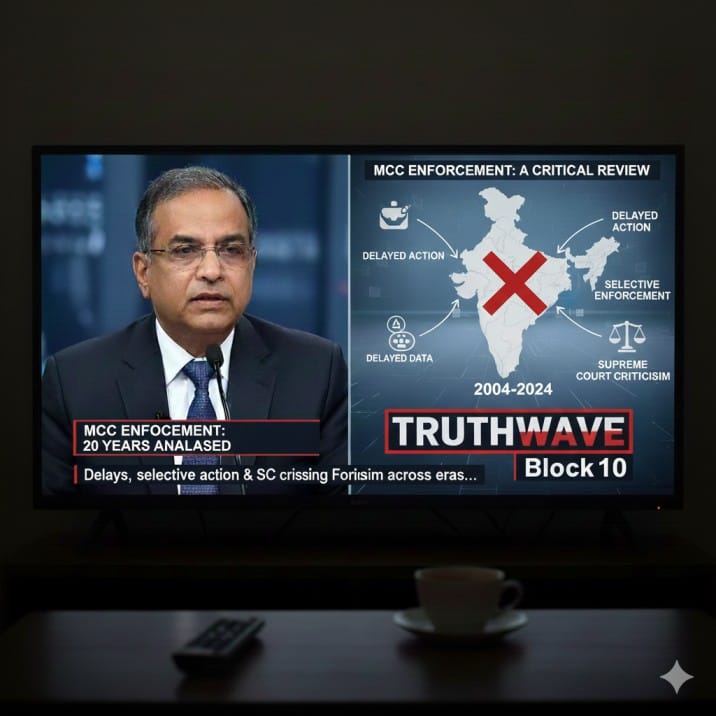
  • model-code-of-conduct-enforcement-india-analysis
    Model Code of Conduct Enforcement in India: Patterns & Delays | TruthWave Block 11 india
  • Investigation: Can Paying a Traffic Challan Online Turn Into a Guilty Plea? Supreme Court Flags V-Courts Problem india
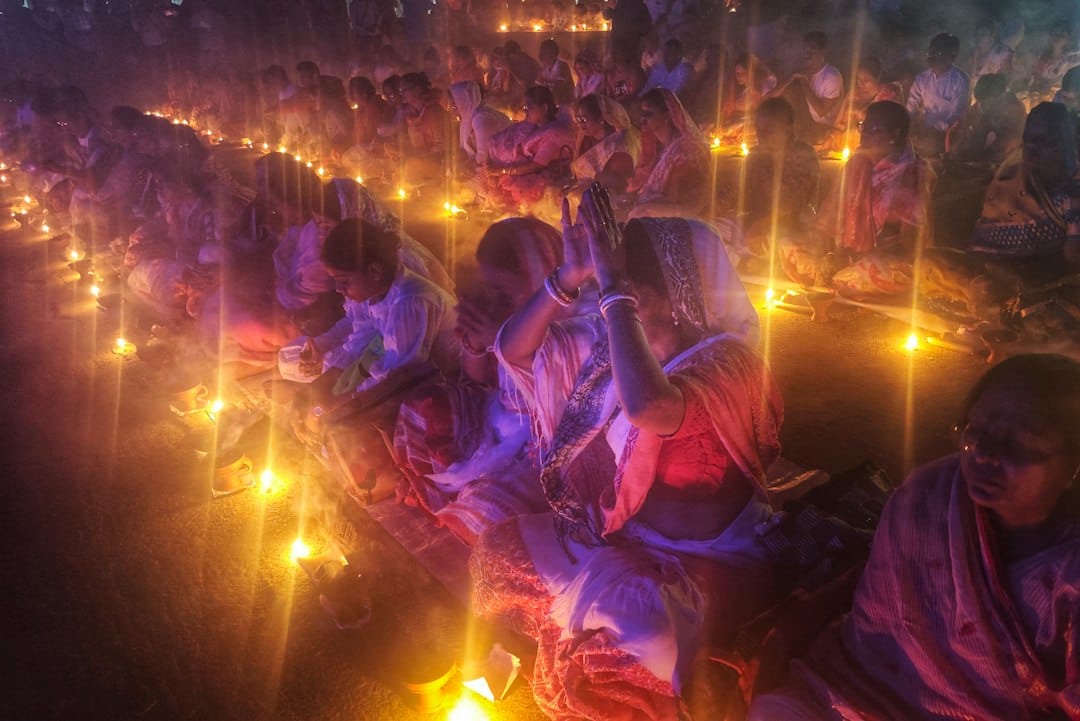
  • করম পুজো উপলক্ষে জনজাতি সম্প্রদায়ের উৎসবের প্রতিনিধিত্বমূলক ছবি
    পশ্চিমবঙ্গে ২২ সেপ্টেম্বর করম পুজোর ছুটি: কোন কোন দফতর বন্ধ india
  • India’s Economy Grew 7.8%: Why Strong GDP and Weak Factory Growth Can Both Be True india
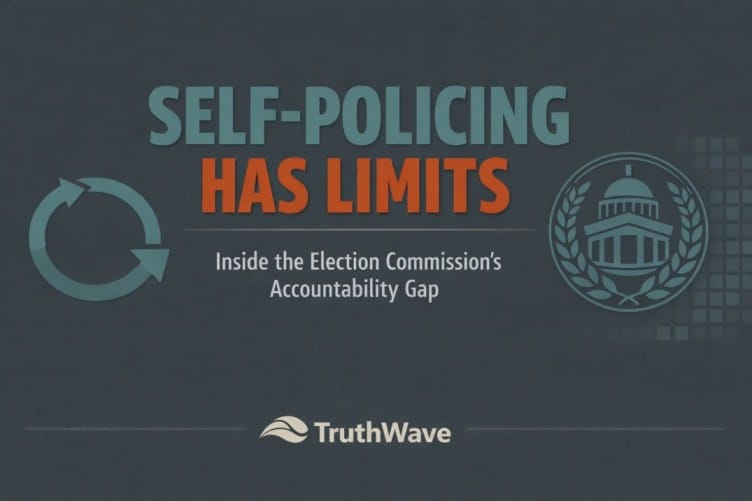
  • Limits of internal accountability within India’s Election Commission
    Internal Checks and Their Limits: Why the Election Commission Polices Itself Public Services
  • India-Uzbekistan Strategic Partnership: Why Uranium, Critical Minerals and $5 Billion Trade Matter india

Tag: TruthWave investigation

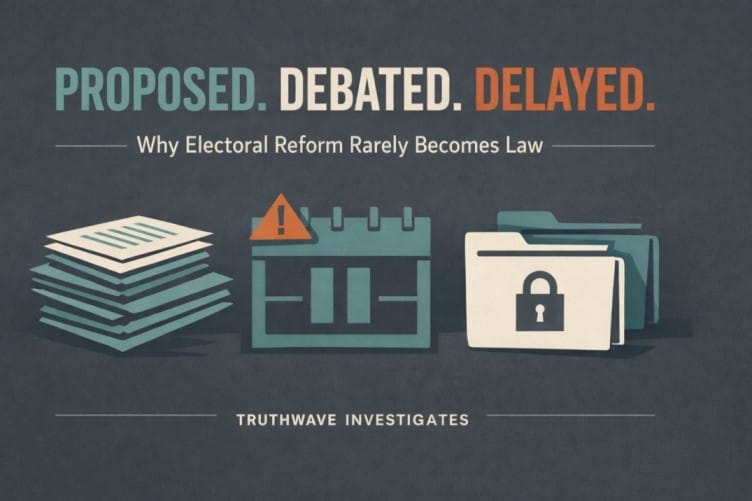
Why Electoral Reform Proposals Rarely Become Binding Law
Posted on 01/17/202601/08/2026 By idmahamad sekh 1 Comment on Why Electoral Reform Proposals Rarely Become Binding Law
Why Electoral Reform Proposals Rarely Become Binding Law

TruthWave Level-5 Public Investigation | Block 21 of 25 Why Electoral Reform Proposals Rarely Become Binding Law SUMMARY India has produced no shortage of electoral reform proposals—from expert committees, courts, civil society, and within Parliament itself. Yet only a small fraction of these ideas become binding law. Block 21 examines the institutional, procedural, and political…

Read More “Why Electoral Reform Proposals Rarely Become Binding Law” »
Public Services

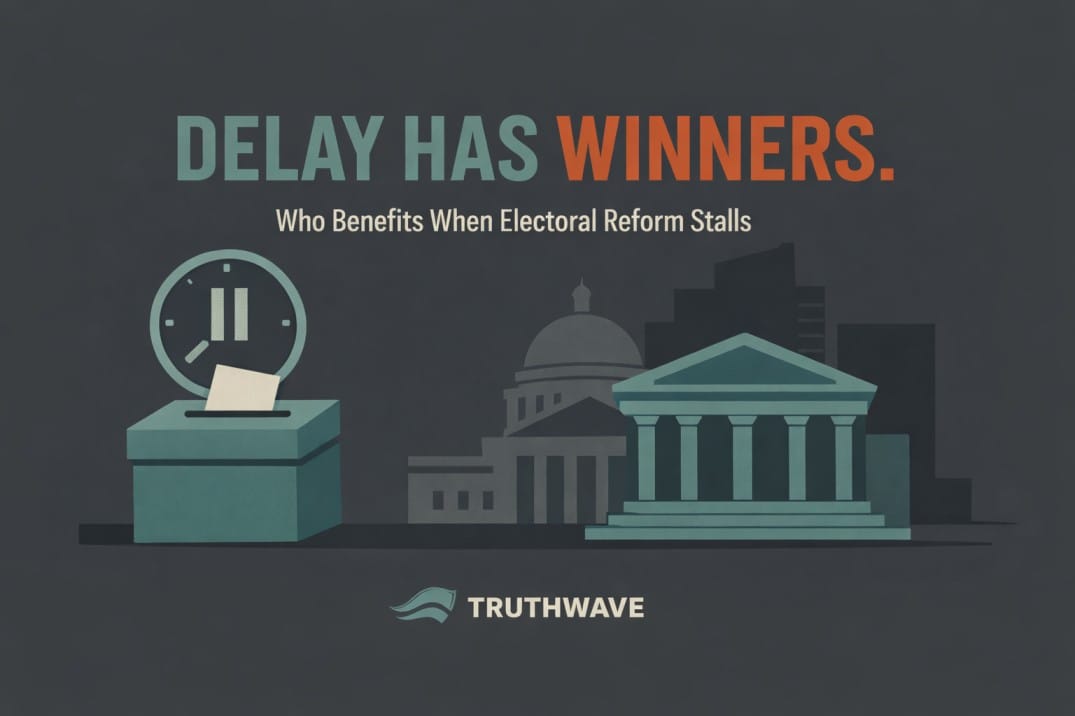
Who Profits From Delay? Mapping the Beneficiaries of Electoral Inaction

Posted on 01/14/202601/08/2026 By idmahamad sekh 1 Comment on Who Profits From Delay? Mapping the Beneficiaries of Electoral Inaction
Who Profits From Delay? Mapping the Beneficiaries of Electoral Inaction

TruthWave Level-5 Public Investigation | Block 20 of 25 Who Profits From Delay? Mapping the Beneficiaries of Electoral Inaction SUMMARY Electoral reform delays are often explained as procedural complexity or political disagreement. But delay itself can produce beneficiaries. Block 20 examines how prolonged inaction in election reform creates structural advantages for certain actors—without requiring illegal…

Read More “Who Profits From Delay? Mapping the Beneficiaries of Electoral Inaction” »

Public Services

Technology, Transparency, and the Limits of Trust in India’s Election System

Posted on 01/10/202601/08/2026 By idmahamad sekh
Technology, Transparency, and the Limits of Trust in India’s Election System

TruthWave Level-5 Public Investigation | Block 19 of 25 Technology, Transparency, and the Limits of Trust in India’s Election System SUMMARY Election technology in India—especially EVMs, VVPATs, and digital processes—was introduced to enhance efficiency and integrity. However, technology alone cannot generate trust. Block 19 examines how transparency gaps, limited public understanding, and restricted auditability have…

Read More “Technology, Transparency, and the Limits of Trust in India’s Election System” »

Public Services

Youth and First-Time Voters:

Posted on 01/07/202601/08/2026 By idmahamad sekh 1 Comment on Youth and First-Time Voters:
Youth and First-Time Voters:

TruthWave Level-5 Public Investigation | Block 18 of 25 How Institutional Signals Shape Democratic Engagement SUMMARY India’s youth and first-time voters represent the largest democratic cohort in the country’s history. Their engagement is shaped not only by campaigns or turnout drives, but by institutional signals—how rules are enforced, how disputes are resolved, and how transparently…

Read More “Youth and First-Time Voters:” »

Public Services

State-Wise Enforcement Gaps: Why Election Rules Apply Unevenly Across India

Posted on 01/03/202601/08/2026 By idmahamad sekh 1 Comment on State-Wise Enforcement Gaps: Why Election Rules Apply Unevenly Across India
State-Wise Enforcement Gaps: Why Election Rules Apply Unevenly Across India

TruthWave Level-5 Public Investigation | Block 17 of 25 State-Wise Enforcement Gaps: Why Election Rules Apply Unevenly Across India SUMMARY India conducts elections across vastly different administrative, political, and security environments. While election laws are uniform, enforcement outcomes often vary by state. Block 17 examines how differences in administrative capacity, policing structures, and political context…

Read More “State-Wise Enforcement Gaps: Why Election Rules Apply Unevenly Across India” »

Public Services

Voter Trust Erosion: Why Confidence Declined Despite Regular Elections bLOCK 16

Posted on 12/31/202501/08/2026 By idmahamad sekh
Voter Trust Erosion: Why Confidence Declined Despite Regular Elections bLOCK 16

TruthWave Level-5 Public Investigation | Block 16 of 25 SUMMARY India has conducted regular, large-scale elections with high voter turnout. Yet, over time, public confidence in electoral fairness has shown signs of strain. Block 16 examines how voter trust can erode even when elections occur on schedule—and why perception, consistency, and enforcement matter as much…

Read More “Voter Trust Erosion: Why Confidence Declined Despite Regular Elections bLOCK 16” »

Public Services

Timing, Delays, and Selective Action: How Enforcement Outcomes Are Shaped

Posted on 12/27/202512/17/2025 By idmahamad sekh 2 Comments on Timing, Delays, and Selective Action: How Enforcement Outcomes Are Shaped
Timing, Delays, and Selective Action: How Enforcement Outcomes Are Shaped

TruthWave Level-5 Public Investigation | Block 15 of 25 SUMMARY Election enforcement is not determined only by rules, but by when and how those rules are applied. In India, delays in decision-making, selective timing of action, and procedural caution have often shaped the impact of Election Commission interventions. Block 15 examines how timing itself became…

Read More “Timing, Delays, and Selective Action: How Enforcement Outcomes Are Shaped” »

Public Services

Administrative Dependence: Why the Election Commission Lacks Enforcement Power

Posted on 12/24/202512/17/2025 By idmahamad sekh 3 Comments on Administrative Dependence: Why the Election Commission Lacks Enforcement Power
Administrative Dependence: Why the Election Commission Lacks Enforcement Power

TruthWave Level-5 Public Investigation | Block 14 of 25 SUMMARY India’s Election Commission of India (ECI) is constitutionally independent, yet operationally dependent. While it supervises elections, its enforcement capacity relies heavily on government-controlled machinery. Block 14 explains how administrative dependence—over staff, police, and state authorities—limits the ECI’s ability to act decisively, even when legal authority…

Read More “Administrative Dependence: Why the Election Commission Lacks Enforcement Power” »

Public Services

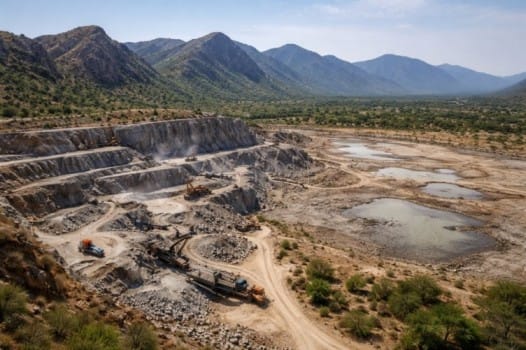
Aravalli hill The 100-Metre Blind Spot: How a Provisional Definition Puts North India’s Water at Risk

Posted on 12/22/202501/02/2026 By idmahamad sekh 1 Comment on Aravalli hill The 100-Metre Blind Spot: How a Provisional Definition Puts North India’s Water at Risk
Aravalli hill The 100-Metre Blind Spot: How a Provisional Definition Puts North India’s Water at Risk

By TruthWave Investigative Desk Introduction: Why This Investigation Matters Now For nearly three decades, environmental protection in India followed a settled constitutional principle: a forest is defined by its ecological character, not by paperwork or technical labels.(Primary source: Supreme Court of India judgments database – https://main.sci.gov.in/judgments) That principle weakened in late 2024–2025. During continuing forest-conservation…

Read More “Aravalli hill The 100-Metre Blind Spot: How a Provisional Definition Puts North India’s Water at Risk” »

Public Services

Legislative Inaction: How Electoral Reform Was Delayed for Two Decades

Posted on 12/20/202512/17/2025 By idmahamad sekh
Legislative Inaction: How Electoral Reform Was Delayed for Two Decades

TruthWave Level-5 Public Investigation | Block 13 of 25 SUMMARY Between 2004 and 2024, India witnessed repeated judicial warnings, expert committee recommendations, and public debates on electoral reform. Yet, comprehensive legislative action remained limited. Block 13 examines how Parliament consistently deferred structural reform of election laws—forcing courts and the Election Commission of India (ECI) to…

Read More “Legislative Inaction: How Electoral Reform Was Delayed for Two Decades” »

india

Posts pagination

1 2 Next
  • Military vehicle model illustrating missile launch reporting in North Korea
    North Korea Missile Launches September 12, 2026: What Happened and Why It Matters International
  • Former Election Commissioners statements
    WHAT FORMER ELECTION COMMISSIONERS SAID: INTERNAL PRESSURE, DISAGREEMENTS & SILENCE INSIDE THE ECI india
  • পুরুলিয়ায় করম পরবের উৎসবের দৃশ্য
    ২২ সেপ্টেম্বর ২০২৬ পশ্চিমবঙ্গে স্কুল ছুটি: করম পুজোর সরকারি নির্দেশ ও ছাত্রছাত্রীদের করণীয় Public Services
  • IndiGo Overbooking Scandal: Why Passengers With Tickets Are Still Being Denied Seats india
  • India Is Building More Solar Power. Why Is So Much Clean Electricity Still Being Wasted? india
  • Election Commission of India’s dependence on government administration for enforcement
    Administrative Dependence: Why the Election Commission Lacks Enforcement Power Public Services
  • Retired IAS IPS election pressure
    Retired IAS & IPS Reveal Ground-Level Pressure in Indian Elections | TruthWave Block 5 india
  • Aston Villa vs Arsenal: Match Preview, Team News and What to Watch india

Copyright © 2026 TruthWave india .

Powered by PressBook News WordPress theme