Why Electoral Reform Proposals Rarely Become Binding Law
By idmahamad sekh
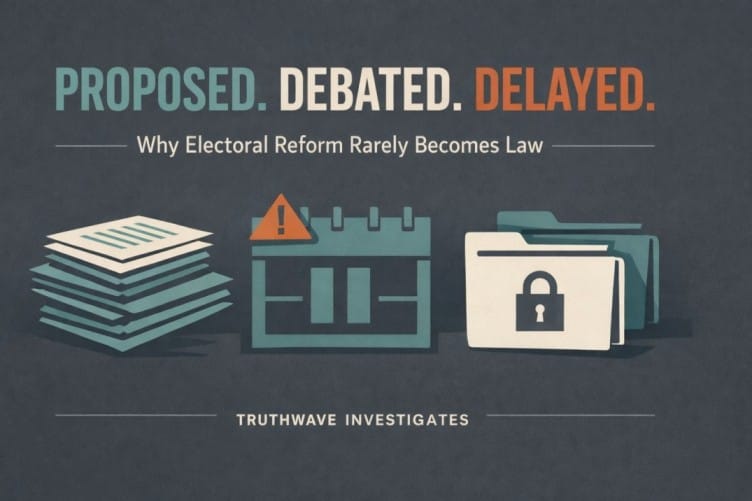
TruthWave Level-5 Public Investigation | Block 21 of 25
Why Electoral Reform Proposals Rarely Become Binding Law
SUMMARY
India has produced no shortage of electoral reform proposals—from expert committees, courts, civil society, and within Parliament itself. Yet only a small fraction of these ideas become binding law. Block 21 examines the institutional, procedural, and political reasons why reform proposals frequently stall before legislative conversion.
INTRODUCTION — IDEAS WITHOUT IMPLEMENTATION
Reform proposals are not rare in Indian democracy.
They emerge after elections, during controversies, and following court judgments. Reports are written, recommendations tabled, and debates recorded. However, movement from proposal to statute remains slow and selective.
This block investigates why well-documented reform ideas struggle to cross the final legislative threshold.
THE MULTI-STAGE BARRIER TO REFORM
For any electoral reform to become law, it must pass through:
- Political consensus building
- Cabinet approval
- Parliamentary scheduling
- Committee scrutiny
- Floor debate and passage
At each stage, reform can be delayed without formal rejection.
LACK OF OWNERSHIP ACROSS POLITICAL ACTORS
Electoral reform often:
- Affects all major parties
- Reduces discretionary space
- Increases compliance costs
As a result, proposals lack a natural “owner” willing to expend political capital to push them through.
Consensus becomes passive agreement—without urgency.
COMMITTEE REPORTS WITHOUT CONSEQUENCES
India’s institutional design allows:
- Expert reports to be tabled
- Recommendations to be acknowledged
- No obligation to act
Without statutory timelines, reports accumulate without translation into law.
Source:
Parliament of India
https://www.parliamentofindia.nic.in
EXECUTIVE CONTROL OVER LEGISLATIVE AGENDA
Even when Parliament discusses reform:
- The executive controls legislative scheduling
- Non-priority bills are deferred
- Reform competes with political urgency
This creates a structural bottleneck between discussion and decision.
RISK AVERSION AND STATUS QUO BIAS
Electoral laws shape political competition.
Uncertainty about how reform may alter outcomes encourages:
- Risk avoidance
- Preference for existing frameworks
- Incremental change over systemic redesign
Delay becomes the safest option.
PEOPLE’S IMPACT
A civil society researcher involved in election monitoring explained:
“Everyone agrees reforms are needed. But no one wants to be the first to change the rules.”
This reflects coordination failure—not disagreement.
WHAT THIS DOES NOT CLAIM
This investigation does not claim deliberate sabotage of reform.
It examines how institutional incentives favor postponement, even when reform is widely supported.
WHY THIS MATTERS
Democracy evolves through law. When reform ideas repeatedly stall, institutions adapt informally rather than structurally—weakening clarity and accountability.
TRUTHWAVE FINDING
India’s electoral reform problem is not lack of ideas.
It is the absence of institutional mechanisms that convert consensus into binding action.
Until reform carries deadlines and accountability, delay will persist.
For analysis of who benefits from prolonged reform delay, see TruthWave Block 20: Who Profits From Electoral Inaction.
LEGAL-SAFETY NOTE
This investigation examines institutional systems and publicly available data. It does not allege individual wrongdoing.
Continue to Block 22:
The limits of internal checks within the Election Commission.
[…] Why Electoral Reform Proposals Rarely Become Binding Law […]