
TruthWave Level-5 Public Investigation | Block 17 of 25
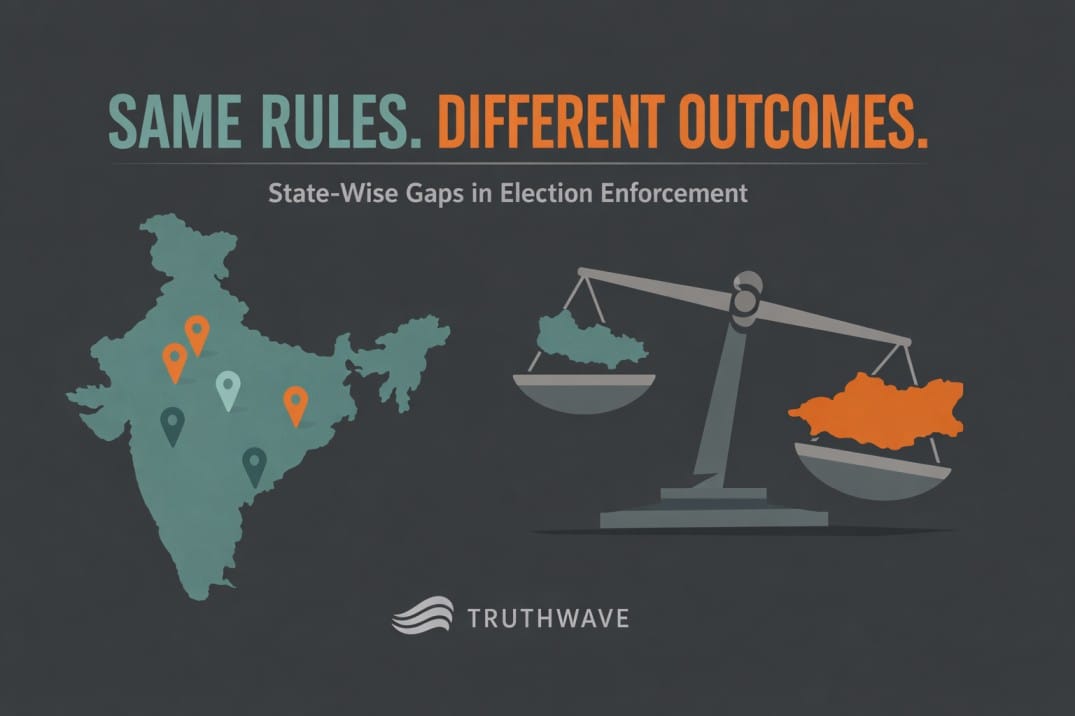
State-Wise Enforcement Gaps: Why Election Rules Apply Unevenly Across India
SUMMARY
India conducts elections across vastly different administrative, political, and security environments. While election laws are uniform, enforcement outcomes often vary by state. Block 17 examines how differences in administrative capacity, policing structures, and political context create uneven application of election rules across states—without changing the law itself.
INTRODUCTION — ONE LAW, MANY REALITIES
India’s election laws apply uniformly across all states.
Yet elections are administered through state-level machinery with differing capacities, incentives, and constraints. As a result, identical rules can produce different enforcement outcomes depending on where elections are held.
This block investigates why state-wise enforcement gaps persist and how structural variation shapes electoral fairness.
THE STRUCTURAL SOURCE OF VARIATION
While the Election Commission of India (ECI) issues central directions, enforcement depends on:
- State police forces
- District administration
- Local election officers
These actors operate under:
- Different resource levels
- Varying security challenges
- Distinct political climates
Uniform rules meet non-uniform conditions.
POLICING CAPACITY AND SECURITY CONTEXT
States differ significantly in:
- Police-to-population ratios
- Experience with election-related violence
- Availability of central armed forces
In high-risk environments, enforcement focuses on:
- Polling security
- Violence prevention
Leaving less capacity for:
- Campaign-period violations
- Financial monitoring
- Code-of-Conduct enforcement
ADMINISTRATIVE LOAD AND SCALE
Large states with:
- High voter populations
- Dense constituencies
- Frequent elections
Place greater administrative load on district officers.
This increases reliance on prioritisation—often delaying non-urgent enforcement actions.
DIFFERENTIAL USE OF CENTRAL FORCES
The ECI deploys central forces to ensure neutrality, but:
- Availability varies by election cycle
- Deployment depends on security assessments
- Not all states receive equal coverage
This affects enforcement confidence and deterrence.
Source:
Election Commission of India
https://eci.gov.in
POLITICAL CONTEXT AND COMPLIANCE
Compliance with ECI directions also depends on:
- Local political cooperation
- Administrative independence
- Prior precedent of enforcement
Where institutional norms are strong, compliance is faster.
Where norms are weak, enforcement requires escalation.
PEOPLE’S IMPACT
A voter from Assam described the contrast:
“Some elections feel tightly controlled. Others feel loose. The rules seem the same, but the seriousness feels different.”
This perception matters—even if legality remains intact.
THE STRUCTURAL CONSEQUENCE
State-wise variation leads to:
- Perception of unequal enforcement
- Confusion over standards
- Reduced deterrence in weaker zones
Democracy remains functional, but consistency weakens.
WHAT THIS DOES NOT CLAIM
This investigation does not claim intentional bias toward any state or party.
It examines how administrative diversity produces uneven outcomes, even under uniform law.
WHY THIS MATTERS
Electoral fairness depends not only on equal rules, but on equal enforcement. When outcomes vary widely by location, public confidence depends on geography rather than law.
TRUTHWAVE FINDING
India’s election rules are uniform.
Their enforcement is structurally uneven due to state-level variation in capacity, security, and administration.
Bridging this gap requires institutional support—not stricter laws alone.
For context on how administrative dependence limits enforcement power, see TruthWave Block 14: Administrative Dependence and Enforcement Limits.
LEGAL-SAFETY NOTE
This investigation examines institutional systems and publicly available data. It does not allege individual wrongdoing.
Continue to Block 18:
Youth and first-time voters: how institutional signals shape democratic engagement.
1 thought on “State-Wise Enforcement Gaps: Why Election Rules Apply Unevenly Across India”