Why Electoral Reform Proposals Rarely Become Binding Law

Reasons electoral reform proposals fail to become binding law in India

TruthWave Level-5 Public Investigation | Block 21 of 25 Why Electoral Reform Proposals Rarely Become Binding Law SUMMARY India has produced no shortage of electoral reform proposals—from expert committees, courts, civil society, and within Parliament itself. Yet only a small fraction of these ideas become binding law. Block 21 examines the institutional, procedural, and political … Read more

Who Profits From Delay? Mapping the Beneficiaries of Electoral Inaction

Structural beneficiaries of delayed electoral reform in India

TruthWave Level-5 Public Investigation | Block 20 of 25 Who Profits From Delay? Mapping the Beneficiaries of Electoral Inaction SUMMARY Electoral reform delays are often explained as procedural complexity or political disagreement. But delay itself can produce beneficiaries. Block 20 examines how prolonged inaction in election reform creates structural advantages for certain actors—without requiring illegal … Read more

Technology, Transparency, and the Limits of Trust in India’s Election System

Limits of transparency in India’s election technology affecting public trust

TruthWave Level-5 Public Investigation | Block 19 of 25 Technology, Transparency, and the Limits of Trust in India’s Election System SUMMARY Election technology in India—especially EVMs, VVPATs, and digital processes—was introduced to enhance efficiency and integrity. However, technology alone cannot generate trust. Block 19 examines how transparency gaps, limited public understanding, and restricted auditability have … Read more

Youth and First-Time Voters:

How institutional signals shape youth trust in Indian elections

TruthWave Level-5 Public Investigation | Block 18 of 25 How Institutional Signals Shape Democratic Engagement SUMMARY India’s youth and first-time voters represent the largest democratic cohort in the country’s history. Their engagement is shaped not only by campaigns or turnout drives, but by institutional signals—how rules are enforced, how disputes are resolved, and how transparently … Read more

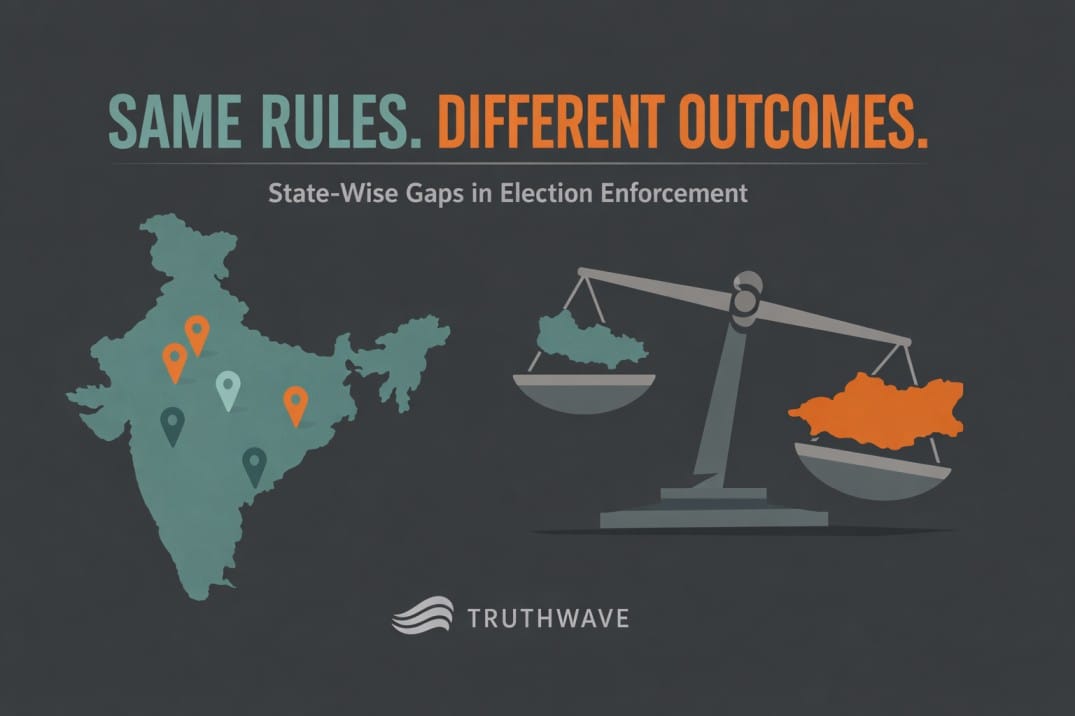
State-Wise Enforcement Gaps: Why Election Rules Apply Unevenly Across India

Uneven enforcement of election rules across Indian states

TruthWave Level-5 Public Investigation | Block 17 of 25 State-Wise Enforcement Gaps: Why Election Rules Apply Unevenly Across India SUMMARY India conducts elections across vastly different administrative, political, and security environments. While election laws are uniform, enforcement outcomes often vary by state. Block 17 examines how differences in administrative capacity, policing structures, and political context … Read more

Voter Trust Erosion: Why Confidence Declined Despite Regular Elections bLOCK 16

Declining voter trust in Indian elections despite regular voting

TruthWave Level-5 Public Investigation | Block 16 of 25 SUMMARY India has conducted regular, large-scale elections with high voter turnout. Yet, over time, public confidence in electoral fairness has shown signs of strain. Block 16 examines how voter trust can erode even when elections occur on schedule—and why perception, consistency, and enforcement matter as much … Read more

Timing, Delays, and Selective Action: How Enforcement Outcomes Are Shaped

Election Commission enforcement delays affecting election outcomes

TruthWave Level-5 Public Investigation | Block 15 of 25 SUMMARY Election enforcement is not determined only by rules, but by when and how those rules are applied. In India, delays in decision-making, selective timing of action, and procedural caution have often shaped the impact of Election Commission interventions. Block 15 examines how timing itself became … Read more

Administrative Dependence: Why the Election Commission Lacks Enforcement Power

Election Commission of India’s dependence on government administration for enforcement

TruthWave Level-5 Public Investigation | Block 14 of 25 SUMMARY India’s Election Commission of India (ECI) is constitutionally independent, yet operationally dependent. While it supervises elections, its enforcement capacity relies heavily on government-controlled machinery. Block 14 explains how administrative dependence—over staff, police, and state authorities—limits the ECI’s ability to act decisively, even when legal authority … Read more

Legislative Inaction: How Electoral Reform Was Delayed for Two Decades

Legislative delay in electoral reform impacting India’s election system

TruthWave Level-5 Public Investigation | Block 13 of 25 SUMMARY Between 2004 and 2024, India witnessed repeated judicial warnings, expert committee recommendations, and public debates on electoral reform. Yet, comprehensive legislative action remained limited. Block 13 examines how Parliament consistently deferred structural reform of election laws—forcing courts and the Election Commission of India (ECI) to … Read more

Judiciary and Election Commission of India | TruthWave Block 12

Judiciary acting as the last institutional guardrail for India’s Election Commission

Judiciary as the Last Guardrail for India’s Election Commission TruthWave Level-5 Public Investigation | Block 12 of 25 SUMMARY Over the last two decades, India’s Supreme Court has repeatedly intervened in election-related matters involving the Election Commission of India (ECI). These interventions were not intended to control the Commission, but to compensate for unresolved structural … Read more