
TruthWave Level-5 Public Investigation | Block 16 of 25
SUMMARY
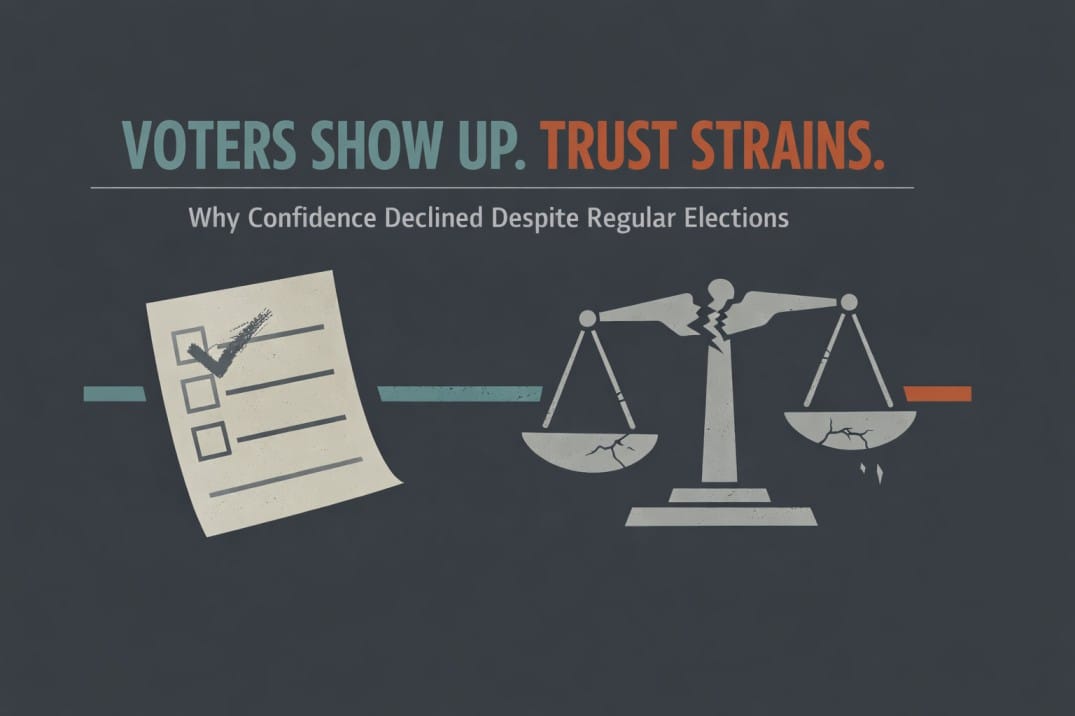
India has conducted regular, large-scale elections with high voter turnout. Yet, over time, public confidence in electoral fairness has shown signs of strain. Block 16 examines how voter trust can erode even when elections occur on schedule—and why perception, consistency, and enforcement matter as much as participation.
Voter Trust Erosion: Why Confidence Declined Despite Regular Elections bLOCK 16
High voter turnout is often cited as proof of democratic health.
However, participation alone does not measure confidence. Trust depends on whether citizens believe rules are applied consistently, institutions act independently, and grievances are addressed meaningfully. In India, repeated disputes, delayed enforcement, and institutional dependence have gradually affected how voters perceive the system.
This block explores why trust weakened despite procedural continuity.
WHAT VOTER TRUST ACTUALLY MEANS
Voter trust rests on three beliefs:
- Elections are administered independently
- Rules apply equally to all participants
- Violations have timely consequences
When any one of these weakens, confidence erodes—even if voting itself continues smoothly.
STRUCTURAL DRIVERS OF TRUST EROSION
1. Repeated Legal Disputes
Frequent court involvement in election matters, while corrective in intent, signals to voters that rules are unsettled. As seen in Block 12, judicial intervention became routine rather than exceptional.
2. Inconsistent Enforcement Visibility
As explored in Blocks 14 and 15, enforcement often appears delayed or uneven due to administrative dependence and timing constraints. Even when decisions are lawful, late outcomes reduce public reassurance.
3. Limited Transparency in Decision-Making
Many Election Commission decisions:
- Are procedurally sound
- Are not fully explained to the public
This gap between action and explanation fuels speculation.
SURVEY SIGNALS AND PUBLIC PERCEPTION
Multiple academic and civil-society surveys over the last decade indicate:
- Stable commitment to voting
- Rising skepticism about fairness and influence
These trends suggest engagement remains high, but confidence is conditional.
Source (institutional reference):
Election Commission of India
https://eci.gov.in
THE ROLE OF SOCIAL MEDIA AND INFORMATION FLOWS
Digital platforms amplify:
- Allegations faster than clarifications
- Partial information over full context
Without rapid, transparent institutional communication, misinformation fills the gap—further stressing trust.
PEOPLE’S IMPACT
A young voter from Delhi described the feeling:
“I still vote. But now I double-check everything I hear. It’s harder to know what to believe.”
This reflects caution, not withdrawal.
WHAT THIS DOES NOT CLAIM
This investigation does not claim elections are illegitimate or manipulated.
It examines how confidence depends on perception, consistency, and communication, not just procedure.
WHY THIS MATTERS
Democracy relies not only on ballots, but on belief. When trust weakens, legitimacy becomes fragile—even if systems continue to function.
TRUTHWAVE FINDING
India’s voter trust challenge is not about participation.
It is about credibility under strain from delayed reform, uneven enforcement, and limited transparency.
Trust is maintained not by holding elections alone—but by convincing citizens that the system treats everyone equally, every time.
For context on how enforcement timing affects public confidence, see
TruthWave Block 15: Timing, Delays, and Selective Action.
LEGAL-SAFETY NOTE
This investigation examines institutional systems and publicly available data. It does not allege individual wrongdoing.
Continue to Block 17:
State-wise enforcement gaps and uneven application of election rules.