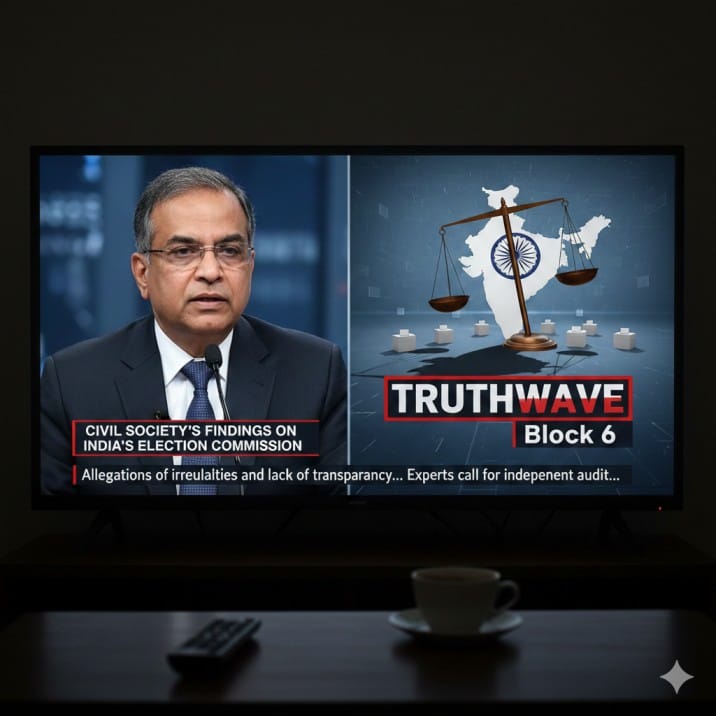
CIVIL SOCIETY VS THE ELECTION COMMISSION: WHAT INDIA’S TOP INVESTIGATIVE GROUPS REVEALED
TruthWave Level-5 Public Investigation | Block 6 of 25
SUMMARY
Independent research groups—ADR, PUCL, Lokniti-CSDS, Common Cause, and global democratic institutions—have spent 20 years documenting deep cracks in India’s electoral system. Their findings show consistent patterns: voter roll errors, turnout irregularities, political finance opacity, selective MCC action, and institutional silence. Block 6 brings these findings together with raw evidence.
INTRODUCTION — WHEN RESEARCH SPEAKS, A DEMOCRACY MUST LISTEN
India’s Election Commission claims to be:
- Neutral
- Transparent
- Independent
But civil society evidence paints a different picture—
not partisan, but structurally weak.
Independent organisations are India’s “watchdogs.”
Their data is extremely important because:
They are not political players
They work for public interest
Their evidence is verifiable
They fill gaps where institutions stay silent
TruthWave now compiles the most important findings from each.
SECTION 1 — ADR (Association for Democratic Reforms)
ADR has been India’s leading election watchdog since 1999.
Their work changed Indian elections:
- Criminal candidate disclosures
- Financial transparency petitions
- Electoral Bonds litigation
- Voter roll studies
- MCC violation patterns
ADR Finding 1: Candidate Criminality Keeps Rising
ADR reports show:
- Over 43% of MPs have criminal cases
- Over 29% have serious charges
- Trend rising across parties
Source:
https://adrindia.org
TruthWave Commentary
Criminalisation of politics makes MCC enforcement harder.
If powerful candidates violate norms, officers hesitate.
System weakness → political space for criminal elements.
ADR Finding 2: Voter Roll Errors Are Massive
ADR studies showed:
- Lakhs of missing voters in state elections
- Duplicate entries
- Block-level inconsistencies
- Mismatched gender/age data
Example:
https://adrindia.org/research-and-reports
TruthWave Commentary
Elections don’t fail at the booth.
They fail at the voter list.
A democracy is only as accurate as its electoral rolls.
ADR Finding 3: Electoral Bonds Destroyed Transparency
ADR fought the electoral bonds case for 7 years.
Findings:
- Bonds allowed unlimited anonymous political donations
- Favoured ruling party in every era
- ECI privately warned government but did not publicly oppose
Supreme Court struck it down in 2024.
TruthWave Commentary
When funding becomes opaque, politics becomes unaccountable.
When the ECI stays silent, institutions become weaker.
ADR Finding 4: MCC Enforcement Is Selective
ADR analysed MCC notices and found:
- Delays in action
- Inconsistent penalties
- More warnings, fewer punishments
- Soft approach toward powerful candidates
TruthWave Commentary
This matches patterns seen in Blocks 2–5.
Systemic inconsistency → political accusations → loss of trust.
SECTION 2 — PUCL (People’s Union for Civil Liberties)
PUCL is India’s oldest human rights civil society organisation.
Their focus:
- Voter rights
- Turnout transparency
- Free speech
- Accountability
PUCL Finding 1: Turnout Data Must Be Released Booth-Wise
PUCL repeatedly demanded:
- Instant booth-wise turnout
- Final Form 17C publication
- Consistency between provisional and final turnout
Source:
https://pucl.org
TruthWave Commentary
Turnout confusion, as explained in Blocks 1–2, harms voter trust.
If PUCL, observers, and citizens all ask for clarity,
why doesn’t ECI modernise?
PUCL Finding 2: VVPAT Must Be Verified More Rigorously
PUCL supported larger VVPAT audits.
They argued:
- 1% sample is too small
- No independent audit exists
- ECI should release audit data
TruthWave Commentary
A black-box democracy is not acceptable to an information-era electorate.
Transparency is not optional.
SECTION 3 — LOKNITI-CSDS
One of India’s top academic research groups.
Their focus:
- Voter behaviour
- Trust in institutions
- Public opinion during elections
Lokniti Finding: Trust in ECI Has Declined Sharply
Their surveys show:
- ECI trust dropping among youth
- Doubts about MCC fairness
- Confusion about turnout reporting
- High distrust in political parties
Source:
https://www.lokniti.org
TruthWave Commentary
When trust declines, democracy becomes fragile.
This is a generational issue now, not merely administrative.
SECTION 4 — COMMON CAUSE
Focus: governance integrity, public institutions, rule of law.
Finding: Election Advertising & Government Media Spend Is Misused
Common Cause exposed:
- Government advertising spikes before elections
- State media used to promote ruling achievements
- MCC loopholes
Source:
https://www.commoncause.in
TruthWave Commentary
ECI needs stronger legal backing to curb government publicity misuse.
Otherwise, incumbency advantage becomes systemic.
SECTION 5 — TRIVEDI CENTRE FOR POLITICAL DATA (Ashoka University)
They analysed:
- Booth-level turnout
- Data inconsistencies
- Voting pattern irregularities
Findings:
- Turnout spikes in certain constituencies
- Voter roll errors influencing results
- Turnout delay increases suspicion
Source:
https://tcpd.ashoka.edu.in
TruthWave Commentary
ECI has not modernized its data publication standards.
A modern electorate expects real-time transparency.
SECTION 6 — INTERNATIONAL INSTITUTIONS
Democracy watchdogs (like IDEA & Carnegie) note:
- India’s elections are strong
- But institutional independence is weakening
- Decreasing transparency
- Increasing executive control over appointments
Source:
https://www.idea.int
TruthWave Commentary
India’s democracy is admired globally—
but institutional weaknesses are visible internationally now.
This affects India’s global credibility.
PATTERN ANALYSIS — WHAT CIVIL SOCIETY REVEALS
Across every report, every dataset, every petition:
Voter roll errors are chronic
MCC enforcement is inconsistent
Turnout transparency is inadequate
Criminal candidates dominate
Data publication is outdated
ECI is not evolving with political reality
Public trust is declining
Civil society is a mirror.
The ECI must look into it, not look away.
CONTINUE TO BLOCK 7
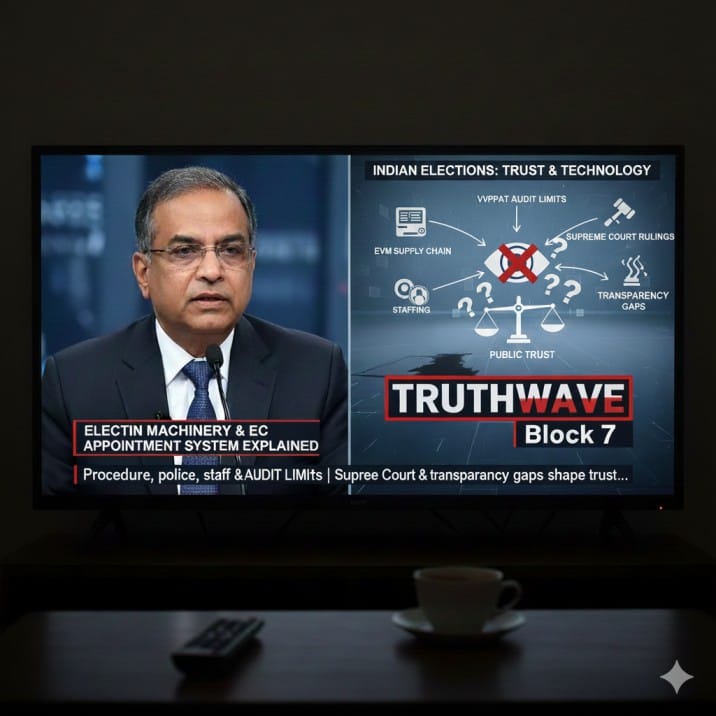
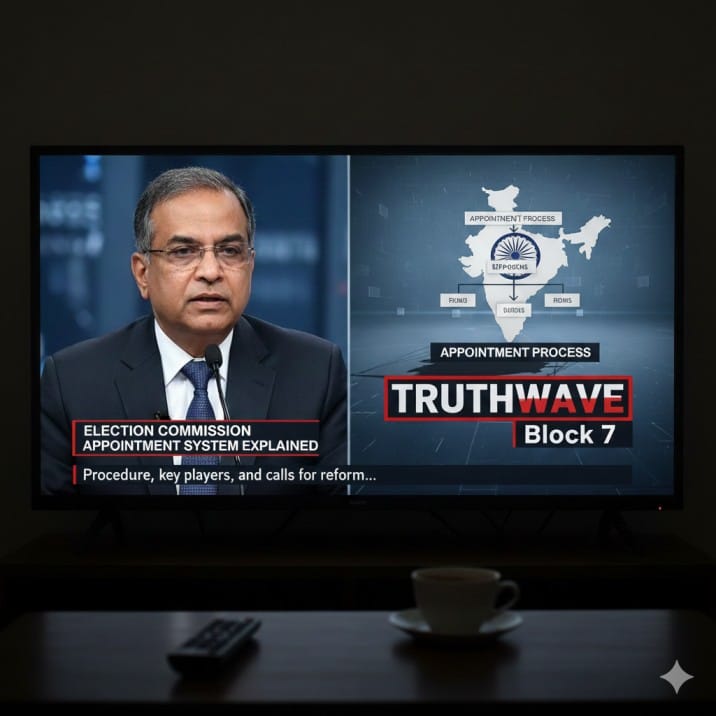
Block 7 exposes the appointment system, showing:
- How Commissioners are selected
- Why governments influence it
- What SC said
- Why independence is at risk
- Global comparisons